
Haak: Leafy Greens in Kashmiri Everyday Cooking
Haak is a name used for leafy greens and their preparations in Kashmiri cooking, particularly associated with collard-like leaves.
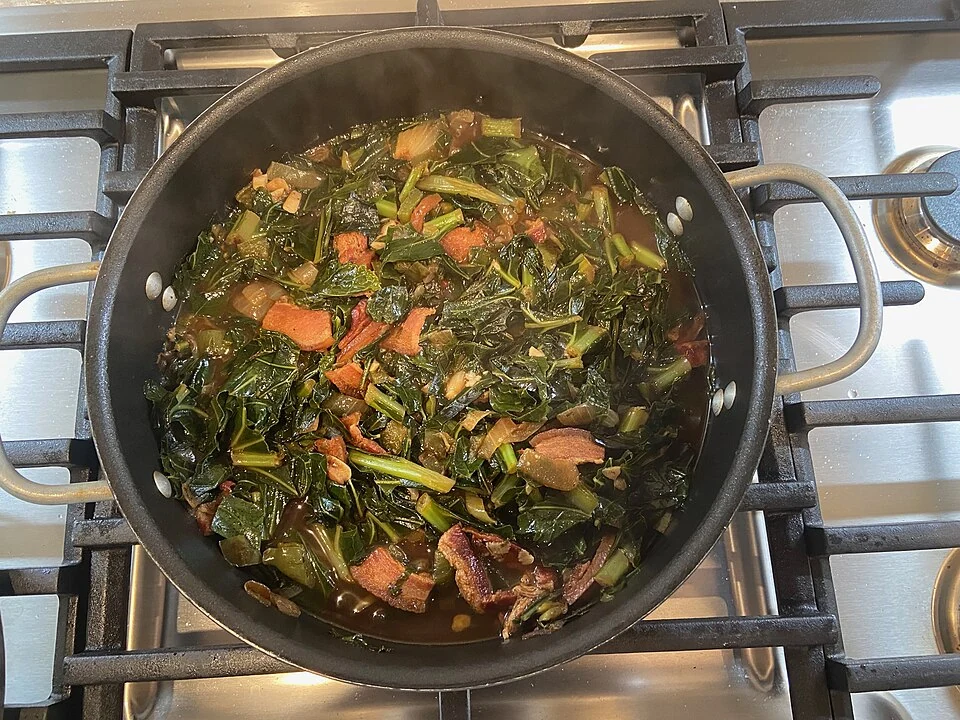
Haak is a name used for leafy greens and their preparations in Kashmiri cooking, particularly associated with collard-like leaves. It is an important everyday subject alongside the more widely promoted meat dishes of wazwan. The word can identify the ingredient or a cooked dish, so a precise description should make clear whether it concerns growing greens, preparing leaves or serving a meal.[1]
Leaves as the central ingredient
Preparations commonly use a relatively direct treatment of the greens in seasoned liquid, allowing the character of the leaves to remain apparent. Leaf size, tenderness and the inclusion of stalks affect the result. A photograph of cooked greens cannot identify the variety or the method by itself, and a dish of spinach should not automatically be labelled haak without supporting context.[1]
The official tourism description includes sabz haakh among the region's dishes. Its presence in such a list is useful, but haak should not be confined to feast cooking: everyday meals and household practice are also central to its identity. Different settings give the same ingredient different culinary roles.[2]
Everyday knowledge and variation
Leafy-green cooking illustrates the value of practical knowledge that is easy to overlook in a menu. Selecting leaves, washing them, judging their tenderness and adjusting the cooking liquid can matter as much as a named spice. A short ingredient list does not mean that a dish requires no skill.
The distinction between a plant name and a culinary name is also important. Botanical identification requires evidence about the plant, whereas a dish can be recognised through local naming and preparation. This entry does not treat all vegetables sold under a familiar market term as one scientifically verified variety.
Read alongside Kashmiri Dum Aloo and Nadru for contrasting vegetable ingredients. The lake-associated cultivation and harvesting context of nadru differs from the leafy-green subject here. Rogan Josh offers a different cooking comparison, helping readers understand the breadth of Kashmiri food without assuming that every meal is organised around the same dishes.
Photograph and map record
Photograph: Nolabob via Wikimedia Commons. Licence: CC BY-SA 4.0. Recorded capture date: 2021-08-18 18:17:53. Resized and converted to WebP; scene content unchanged. This is a dated view, not confirmation of the site’s present appearance.

Map marker: 34.083, 74.797. Editorial regional-context marker for Srinagar. This subject is not a single physical destination: the point is not a birthplace, workshop, harvest site, species range, guaranteed wildlife locality or boundary of language use. View location on OpenStreetMap · View Google Maps · Google directions · OpenStreetMap directions.
Research checked: 14 October 2026. For a visit, confirm current access, transport and opening information with the relevant authorities. This encyclopedia profile provides geographical and historical context.
Sources & references
[1] Haak — secondary historical/geographical overview
https://en.wikipedia.org/wiki/Haak ↗
[2] Ministry of Tourism: Wazwan and haakh
Photograph and licence
https://commons.wikimedia.org/wiki/File:Collard_greens_on_a_stovetop.jpg ↗
Related reading

Aali Masjid: Open Ground and a Historic Srinagar Mosque
Aali Masjid, also written Ali Masjid, is a historic mosque in Srinagar's Eidgah area.

Amar Singh College: Education, Campus Heritage and Institutional Change
The growth of an educational institution from a technical institute, with campus conservation and academic resources.
Bakshi Stadium: Football and a Public Sports Venue in Srinagar
Bakshi Stadium is a major sports venue in Srinagar, particularly associated with football.