
Kalhana: Poet and Author of the Rajatarangini
Kalhana was a twelfth-century Kashmiri poet and chronicler best known for the Sanskrit Rajatarangini , usually translated as “River of Kings.” Written in the mid-twelfth century, the work narrates Kashmir's rulers and political fortunes. His importance rests chiefly on this surviving text rather than on a separately documented, complete account of his private life.
Kalhana was a twelfth-century Kashmiri poet and chronicler best known for the Sanskrit Rajatarangini, usually translated as “River of Kings.” Written in the mid-twelfth century, the work narrates Kashmir's rulers and political fortunes. His importance rests chiefly on this surviving text rather than on a separately documented, complete account of his private life.[1]
A chronicle in verse
The Rajatarangini combines historical narrative with the literary form of Sanskrit poetry. Its books move through accounts of kings, succession, conflict and conduct. The narrator's judgments are part of the work: a reader encounters an interpretation of rulership as well as a sequence of events.[2]
Kalhana refers to earlier records and traditions, while modern scholarship distinguishes the evidential character of early legendary material from later accounts closer to his own period. Reading the chronicle does not require treating every reign and date as equally secure. The question is how a particular passage relates to other evidence.[1]
Manuscripts and later readers
Stein's edition and translation are important routes through which later readers have approached the work. A manuscript folio, a printed Sanskrit edition and an English translation are different objects. Each has its own date, copying or editorial history, even when all carry Kalhana's text.[3]
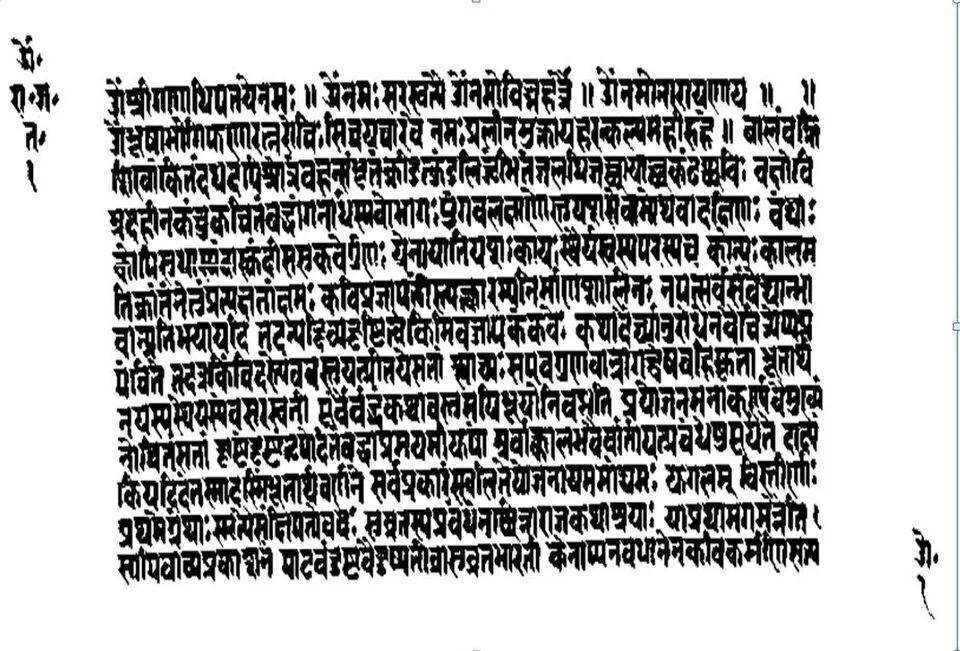
The accompanying manuscript illustration is consequently not Kalhana's handwriting or portrait. It documents a later material witness to the text. Script, layout and the record of a copyist can illuminate transmission without proving what the author's original manuscript looked like.
Kalhana also matters to the way Kashmir is researched. Literary place names invite comparison with buildings, inscriptions and archaeological sites, while differences between evidence types remain essential. Read Martand and Burzahom for two very different kinds of material history. Kashmiri Language supplies a contrast with his Sanskrit literary medium. The Srinagar marker is regional context for a biography; it is not an authenticated birthplace, residence or authorial writing room.
Image and map record
Image: R?j?naka Ratnaka??ha (copyist); historical manuscript via Wikimedia Commons. Licence: Public domain. Recorded capture date: ca.1648–49. Resized and converted to WebP; image content unchanged. This is a dated view, not confirmation of the site’s present appearance.


Map marker: 34.083, 74.797. Editorial regional-context marker. This biography, craft or cultural tradition is not a single physical destination. The point is not a verified birthplace, residence, workshop, exclusive origin, performance venue or cultural boundary. View location on OpenStreetMap · View Google Maps · Google directions · OpenStreetMap directions.
Research checked: 14 October 2026. For a visit, confirm current access, transport and opening information with the relevant authorities. This encyclopedia profile provides geographical and historical context.
Sources & references
[1] Reference overview: Kalhana
https://en.wikipedia.org/wiki/Kalhana ↗
[2] Reference overview: Rajatarangini
https://en.wikipedia.org/wiki/Rajatarangini ↗
[3] Kalhana’s Rajatarangini: Stein edition and translation bibliographical record
Image and licence
Related reading

Aali Masjid: Open Ground and a Historic Srinagar Mosque
Aali Masjid, also written Ali Masjid, is a historic mosque in Srinagar's Eidgah area.

Agha Shahid Ali: Poetry, Memory and Kashmir
Agha Shahid Ali was a Kashmiri-American poet who lived from 1949 to 2001. Born in New Delhi and raised in a family associated with Kashmir, he develop

Amar Singh College: Education, Campus Heritage and Institutional Change
The growth of an educational institution from a technical institute, with campus conservation and academic resources.