
Kashmir Saffron: Plant, Cultivation, Harvest and Geographical Identity
An account of Kashmir saffron from corm and flowering crop to dried spice, research, trade and geographical indication.
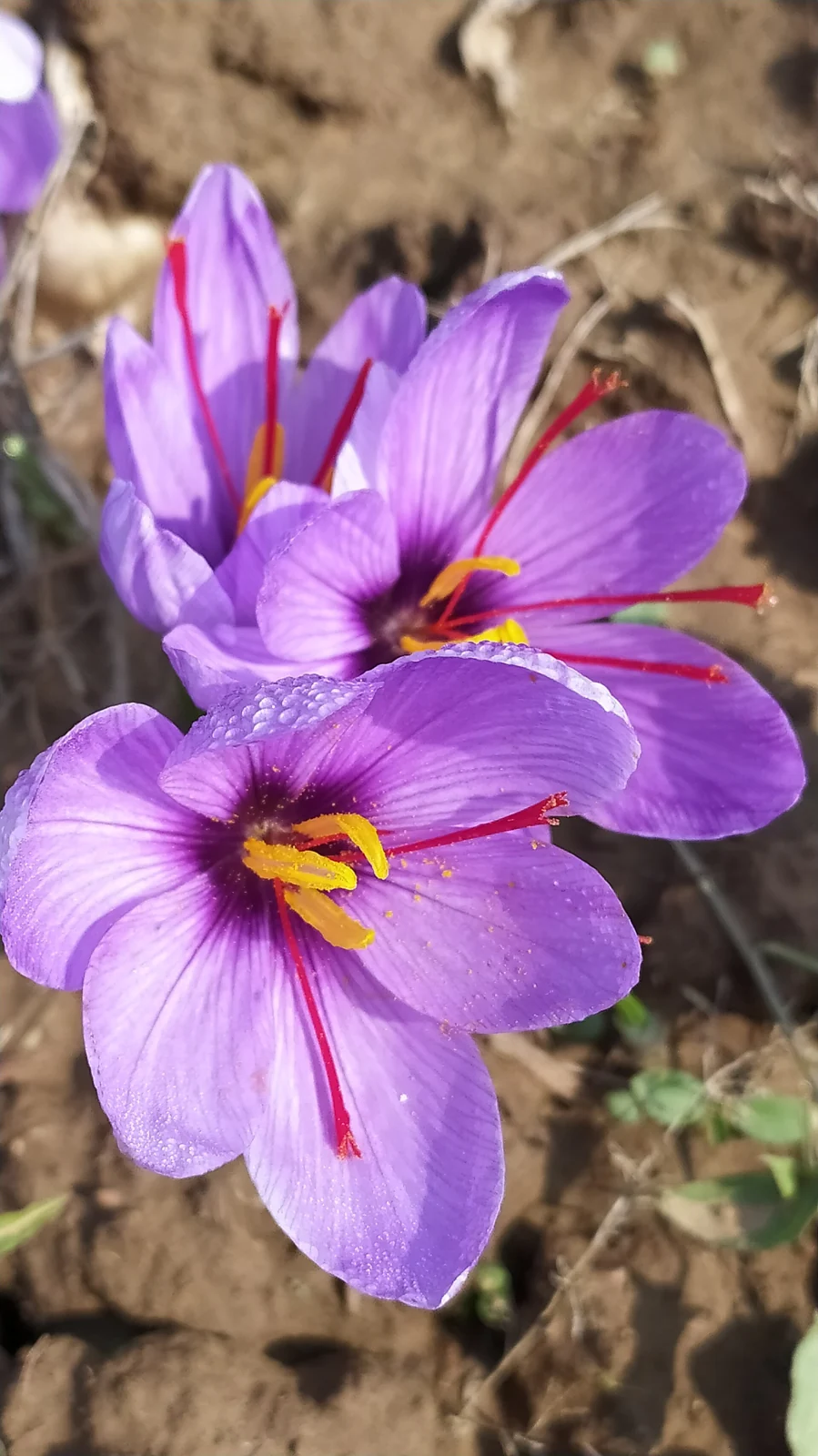
Kashmir saffron is an agricultural product whose identity brings together a flowering plant, a specialised harvest and a particular growing landscape. In Kashmir, its strongest geographical association is with Pampore and the surrounding cultivation belt in Pulwama district. The district administration identifies saffron among Pulwama’s characteristic agricultural products. A field in bloom, a packet of dried threads and the registered geographical indication are different parts of the same story, rather than interchangeable descriptions of a single object.[1]
The crop beneath the flower
The spice comes from dried Crocus sativus stigmas. The plant is propagated through corms, the underground storage structures from which the plant grows. The agronomic review consulted here describes it as a sterile crop reproduced vegetatively. The farmer is maintaining a population of corms, not simply sowing a new crop from seed each season. The purple flower is the most visible stage, but the production cycle also includes dormancy, flowering and the condition of the underground plant.[2]
The review distinguishes dry dormant-season conditions from the cooler, moister conditions associated with flowering. The timing of weather therefore matters as well as its overall amount. This explains the crop’s biology without prescribing irrigation for every Kashmir farm.[2]
Pampore, karewas and cultivated ground
Pampore is a town in Pulwama district on the eastern side of the Jhelum. Its association with saffron has made “saffron town” a familiar description. The town marker used for this article provides regional orientation, rather than identifying a particular field. Individual holdings are working agricultural land, and the appearance of one flowering patch cannot establish the condition or size of the whole cultivation belt.[6]
The accompanying photograph documents saffron flowers in Pampore. Its photographer describes their setting as the raised karewa ground associated with local cultivation. This is useful visual evidence of flowers and soil at a recorded place and date. It does not establish the yield of that field, the certification of a subsequent packet or the exact ownership boundary. Keeping the photograph’s subject precise makes it valuable without asking it to prove more than it shows.
From cultivation to the finished spice
Harvest and handling are central to saffron’s value because the usable spice represents only a small part of the flower. After collection, separation and drying turn a delicate fresh plant part into a product that can be stored and traded. The agronomic literature treats post-harvest drying as a consequential step: different drying conditions affect the retained pigments and other quality characteristics. The detailed temperature recommendations in a research paper belong to a tested process, rather than a household authenticity test.[2]
Research at SKUAST-Kashmir’s saffron and seed-spice station in Pampore has examined corm weight and planting density. A study published in 2023 compared several corm-weight groups and densities under its experimental conditions. Its importance for an encyclopedia is the demonstration that planting material, field arrangement and economic return are studied together. A result from a particular trial should not be presented as a guaranteed yield for a different soil, year or grower.[3]
That distinction also separates a crop profile from cultivation instructions. An account of saffron can explain why corm size, population and handling matter while directing growers to local extension advice for implementation. The skill of production includes decisions made before flowers appear and work after they are picked. Concentrating only on the brief flowering scene overlooks those less visible stages.
Geographical indication and traceability
The Intellectual Property India register lists Kashmir Saffron as registered GI application number 635, with an agricultural classification and certificate date of 1 May 2020. The applicant is the Agriculture Production Department of Jammu and Kashmir. The register provides a documentary reference for the protected product name; it should not be replaced by an undated promotional claim that every packet bearing the word “Kashmir” is certified.[4]
For a buyer, origin, seller identity and product documentation are separate questions from colour and fragrance. An encyclopedia entry cannot certify a particular consignment from a photograph or a home experiment. Traceability is more useful when the product’s stated origin can be connected with the relevant registered producer or authorised-user documentation. This is an explanation of what evidence is needed, rather than an endorsement of a seller.
A Spices Board document for a December 2024 buyer–seller meeting records efforts to connect regional growers and organisations with traders and exporters. It also notes the 2020 GI recognition. The document demonstrates an organised trade context, but its historical price figures should not be used as a quotation for today’s market. The price of a particular lot depends on its date, characteristics and transaction.[5]
Kashmir saffron connects agricultural geography with the broader regional economy. Compare Kashmir pashmina for another product whose place identity depends on production and documentation. The Jhelum River entry introduces the wider valley setting, while Srinagar Airport explores a different part of regional connectivity.
Photograph and map record
Photograph: Yasir Yousuf Ahanger via Wikimedia Commons. Licence: CC BY-SA 4.0. Recorded capture date: 2021-10-30 12:00:51. Resized and converted to WebP; scene content unchanged. This is a dated view, not confirmation of the site’s present appearance.

Map marker: 34.02, 74.93. Pampore town locator from the secondary town reference; not a particular saffron field or the full GI cultivation area. View location on OpenStreetMap · View Google Maps · Google directions · OpenStreetMap directions.
Research checked: 14 October 2026. For a visit, confirm current access, transport and opening information with the relevant authorities. This encyclopedia profile provides geographical and historical context.
Sources & references
[1] District Pulwama — Agricultural profile
[2] Agronomic management of saffron — Indian Journal of Agronomy
https://pub.isa-india.in/index.php/ija/article/download/5248/4923/5443 ↗
[3] Alie and colleagues, 2023 — Corm weight and planting-density trial at Pampore
https://www.cornous.com/downloadpdf/169 ↗
[4] Intellectual Property India — Kashmir Saffron GI 635
https://search.ipindia.gov.in/GIRPublicSearch/Application/Details/635 ↗
[5] Spices Board — December 2024 buyer–seller meeting
https://www.indianspices.com/sites/default/files/BSM%20SRINAGAR-%20SAFFRON-compressed.pdf ↗
[6] Pampore — Secondary geographical locator
https://en.wikipedia.org/wiki/Pampore ↗
Photograph and licence
https://commons.wikimedia.org/wiki/File:Bunch_of_blooming_saffron_flowers.jpg ↗