
Kashmir Pashmina: Fibre, Artisan Work and the Identity of a Shawl
The regional production chain behind Kashmir pashmina, with distinctions between fibre, weaving, decoration and certification.
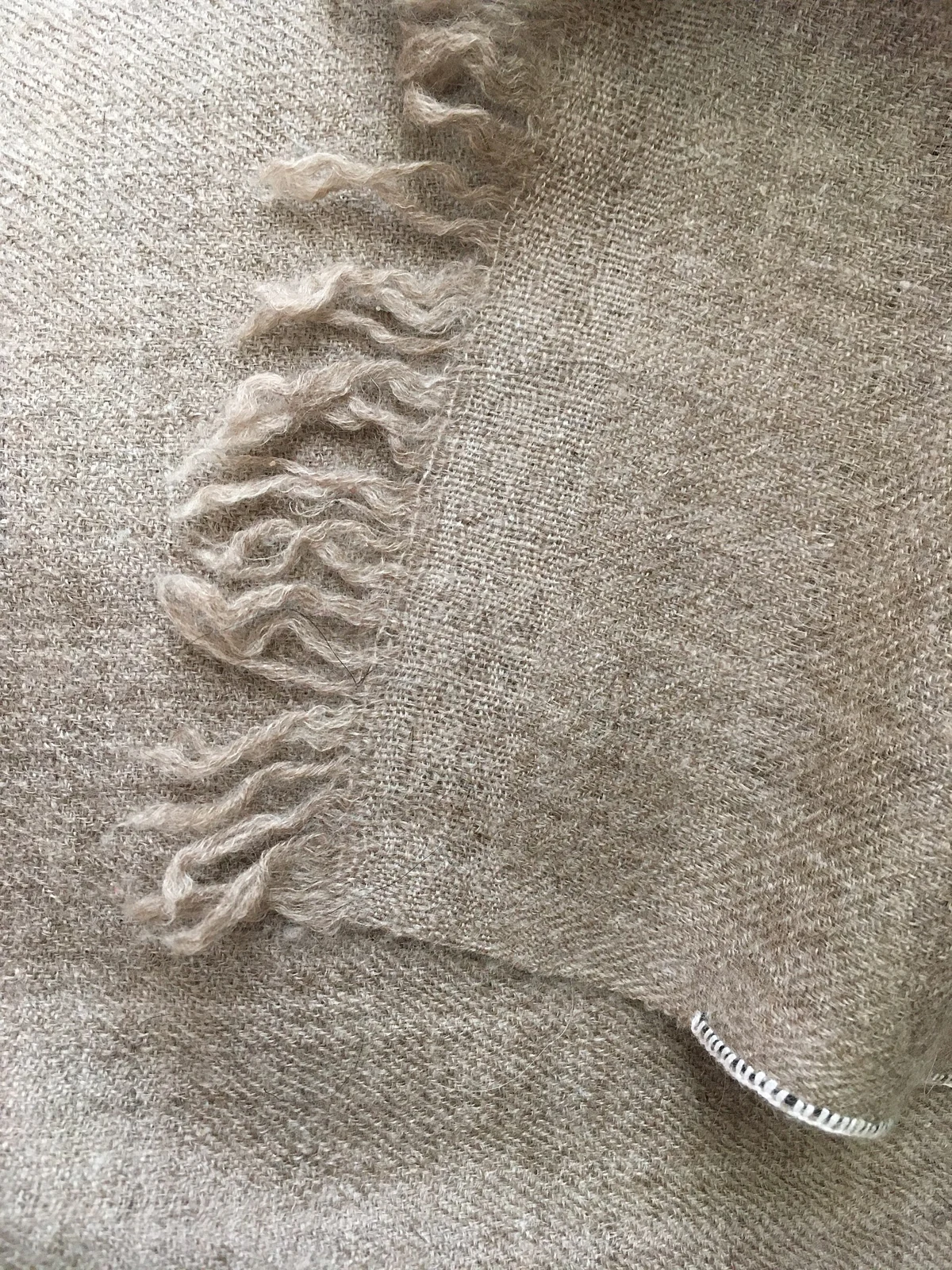
Kashmir pashmina is best understood as a relationship between fine animal fibre and skilled textile making. A shawl begins far before the finished cloth reaches a shop: fibre must be collected, cleaned, prepared, spun and woven, and the fabric may then receive additional finishing or decoration. The name therefore carries more information than a description of softness. It connects material, production method and place, with Srinagar forming an important centre of the craft’s working and commercial landscape.
Fibre, yarn and cloth are different stages
Pashmina is a fine down fibre obtained from goats, distinct from the coarser outer guard hair. The fibre review published in the Indian Journal of Fibre & Textile Research describes the importance of separating the two before making higher-value textiles. It also identifies Changthangi goats in Ladakh within the Indian production geography. This gives the Kashmir shawl a regional connection extending beyond the city where it is woven: the pastoral landscape and the artisan workshop form different parts of the supply chain.[1]
The same review emphasises fibre fineness and records variation according to source and grade. “Pashmina” should consequently not be treated as a statement that every fibre has an identical diameter or that all finished cloth feels the same. The material’s properties interact with yarn and fabric construction. A fibre sample, a spun thread and a woven shawl need different descriptions even when all belong to the same production sequence.[1]
The work of making a shawl
A field study published in 2012 examined traditional processing among artisans in Srinagar, Budgam and Ganderbal. It organised the work into preparation before spinning, spinning, weaving and finishing. Its account describes cleaning and dehairing, the preparation of fibre for spinning and the use of the yander or spinning wheel. These are skilled stages in transforming loose material into yarn that can be handled on a loom.[2]
The researchers also describe the preparation of warp and weft and the roles of the dyer and other specialised workers. This matters because a shawl need not be the work of one person carrying out every task in one room. The finished textile can embody a chain of expertise. The study documents a traditional method at the time of its fieldwork; it is not proof that every present-day workshop uses precisely the same tools or division of labour.[2]
Seen in this way, hand production is not simply a slower version of an industrial process. The handling of fibre, the control of yarn and the decisions made during weaving are part of the textile’s character. An informative object record would identify those contributions where they are known. Naming only the retailer can leave the spinner, weaver and finishing workers invisible, even though their work is essential to the finished cloth.
Pashmina, kani and sozni
The Craft Development Institute’s GI descriptions distinguish Kashmir Pashmina from Kani Shawl and Kashmir Sozni. Its pashmina specification refers to pure pashm fibre, hand-spun yarn and cloth handwoven by artisans of Jammu and Kashmir. Kani describes a particular weaving method using small wooden implements and written design instructions known as talim. Sozni concerns fine needle embroidery. These terms describe related but different aspects of textile making.[3]
A shawl can therefore be discussed through its material, weave and decoration without assuming that those words are synonyms. A plain handwoven pashmina need not carry elaborate embroidery, and a description of a patterned technique does not by itself establish the fibre composition. This distinction makes catalogue entries more accurate and helps readers appreciate the work behind a textile without relying on a single luxury label.
The documented product name
The official GI register identifies Kashmir Pashmina as application number 46 and lists it as a registered handicraft. Its documentary history distinguishes the filing date of 9 December 2005 from the certificate document dated September 2008. Those are stages in an administrative process, not competing dates for the invention of the craft. The authorised-user records provide a further layer of information about who is registered in relation to the protected name.[4]
The Craft Development Institute states that its Pashmina Testing and Quality Certification Centre was established in 2013. Testing, certification and labelling offer a more specific basis for product claims than an attractive photograph or the word “pure” on an advertisement. This does not mean that every shawl sold in Srinagar has passed through that centre, or that the appearance of a label alone settles every question about provenance.[5]
Srinagar’s official craft guide recommends recognised or registered sellers, certification checks and proper billing. It also describes the city’s different craft and shopping areas. The geographical setting is therefore a network of production and trade rather than a single workshop. This entry is filed under Srinagar as an editorial centre of reference, while recognising the wider craft geography documented by the artisan study.[6]
The photograph illustrates cloth described by its contributor as handwoven Kashmir pashmina from Srinagar. It is an image of a textile, not a laboratory report or GI certificate. Compare Kashmir saffron for another relationship between regional identity and product documentation, and Kargil district for broader regional trade history. Srinagar district introduces the city and district setting.
Photograph and map record
Photograph: AG via Wikimedia Commons. Licence: CC BY-SA 4.0. Recorded capture date: 2022-07-16 14:24:10. Resized and converted to WebP; scene content unchanged. This is a dated view, not confirmation of the site’s present appearance.

Map marker: 34.083926, 74.845176. Existing Srinagar article’s representative city-view marker; craft production is distributed across workshops and districts. This is not a workshop, shop or fibre-production site. View location on OpenStreetMap · View Google Maps · Google directions · OpenStreetMap directions.
Research checked: 14 October 2026. For a visit, confirm current access, transport and opening information with the relevant authorities. This encyclopedia profile provides geographical and historical context.
Sources & references
[1] Shakyawar and colleagues, 2013 — Pashmina fibre: production, characteristics and utilisation
https://nopr.niscpr.res.in/handle/123456789/19255 ↗
[2] Yaqoob and colleagues, 2012 — Traditional pashmina shawl processing in Kashmir
https://nopr.niscpr.res.in/handle/123456789/13865 ↗
[3] Craft Development Institute — Pashmina, Kani and Sozni GI specifications
https://cdiptqccgi.com/gi-crafts ↗
[4] Intellectual Property India — Kashmir Pashmina GI 46
https://search.ipindia.gov.in/GIRPublicSearch/Application/Details/46 ↗
[5] Craft Development Institute — Testing and certification centre
[6] District Srinagar — Local craft and documentation guidance
https://srinagar.nic.in/local-craft/ ↗
Photograph and licence
https://commons.wikimedia.org/wiki/File:Handwoven-kashmir-pashmina.jpg ↗
Related reading
Chashma Shahi: The Royal Spring and Its Mughal Garden
The spring-centred design, Mughal commission, traditions and setting of Chashma Shahi.
Dachigam National Park: Landscape, Hangul and Conservation
Dachigam’s protection history, varied terrain, water connections and wildlife-conservation context.
Dal Lake: Waterways, Floating Gardens and Life on the Lake
An introduction to Dal Lake’s connected basins, working waterscape, floating gardens, boats and cultural setting.