
Leh Palace: Namgyal Kingship and Himalayan Building Traditions
Leh Palace’s royal history, vertical organisation, earth-and-timber construction and relationship to Leh’s historic townscape.
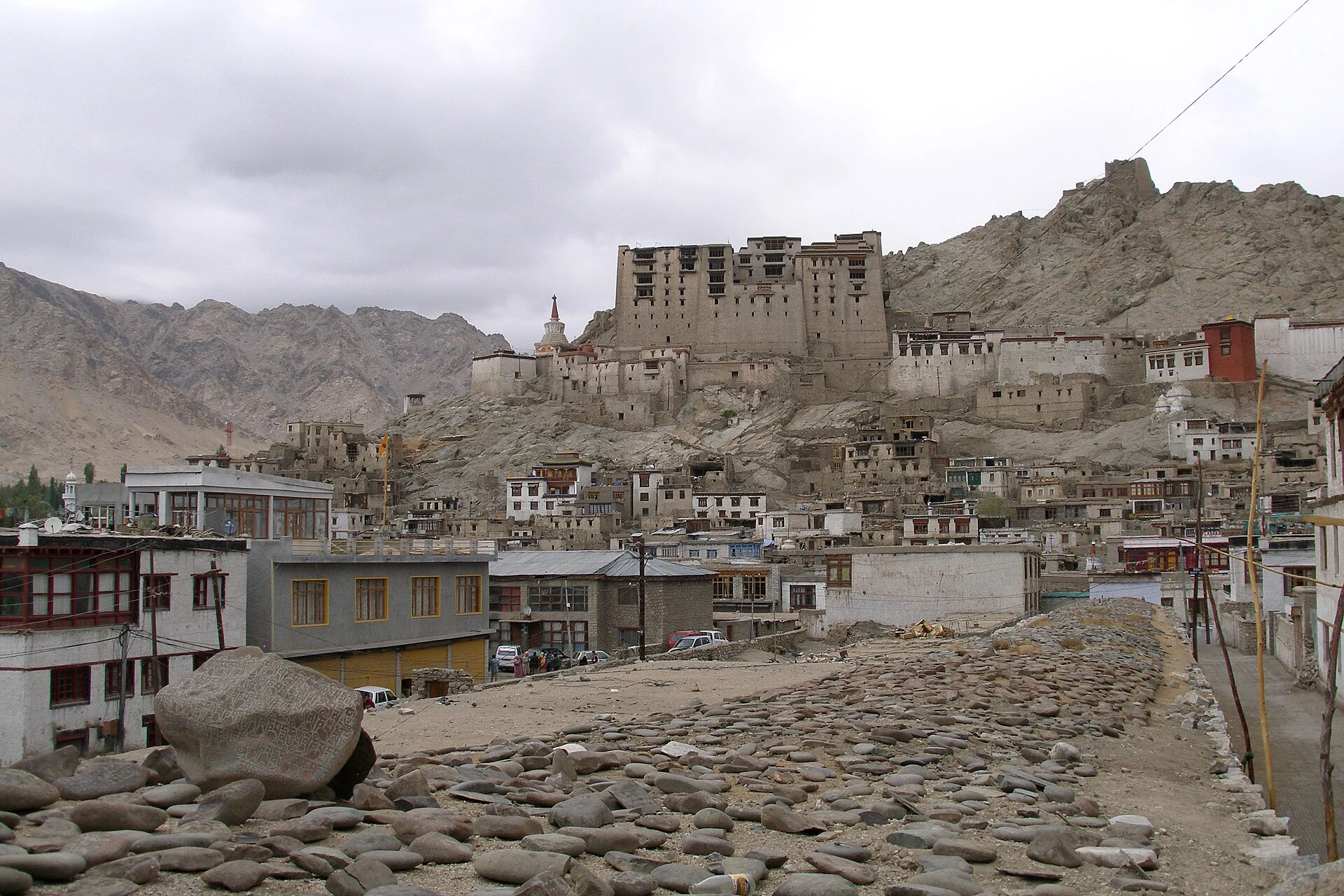
Leh Palace, also known as Lachen Palkar or Lachen Palkhar, is a former royal residence overlooking Leh in Ladakh. The Ministry of Tourism associates its seventeenth-century construction with King Sengge Namgyal. Its nine-storey form makes the palace an important part of the town’s historic skyline, while its arrangement of storage, living and ceremonial spaces connects architecture with the practical organisation of royal life.[1]
Building with stone, earth and timber
The National Culture Fund’s monument account describes a structure built from stone, sun-dried mud brick and local timber. The palace follows the contours of its rocky site. Horizontal timber bands interrupt the masonry, and the account associates this feature with control of vertical cracking. The upper levels use mud brick, reducing the load carried below. Small openings lower down contrast with the more elaborate projecting balconies of the upper facade.[2]
These details help explain the building as a response to material, terrain and structural needs. The palace’s scale comes from the accumulation of levels on a rocky slope, not from a uniform stack of modern floors. Earth construction, timber connections and the relationship between walls and openings are therefore essential to its character. Decorative features should be read alongside these less immediately visible building choices.[2]
Royal spaces and historical change
The tourism account distinguishes the upper royal quarters from lower spaces used for storage and other practical purposes. The National Culture Fund identifies an important open courtyard, Khatok Chhenmo, with social and cultural events held in honour of the king. Together, these accounts suggest a palace organised through several kinds of activity, rather than a building devoted entirely to ceremonial display.[1][2]
The secondary history connects the palace’s abandonment with Dogra expansion in the nineteenth century and the royal family’s move to Stok. It also records conservation by the Archaeological Survey of India. These historical changes distinguish the palace’s period as a residence from its later life as a monument. Accounts of its construction and abandonment should not be used as a substitute for the history of the whole town.[3]
The palace in Leh’s heritage landscape
The district’s culture-and-heritage overview places the palace alongside monasteries, Stok Palace Museum, educational institutions, a mosque and the Moravian Church. This wider list shows that Leh’s heritage is not confined to one royal monument or one building tradition. A connected encyclopedia can use the palace as an introduction to the townscape while giving these other institutions independent entries.[4]
Location and connected reading
The map marker locates the palace above Leh; it is not a statement of current access to every level. The photograph is a dated historical view, and should be read with its credit and capture date. Current opening arrangements belong to the monument’s managing authority.
Read Kargil district for another part of Ladakh’s settlement and trade history. Compare Pari Mahal and Raghunath Temple, Jammu for other relationships between patronage, landscape and architecture.
Photograph and map record
Photograph: Vyacheslav Argenberg via Wikimedia Commons. Licence: CC BY 4.0. Recorded capture date: 2007-09-10 09:47:54. Resized and converted to WebP; scene content unchanged. This is a dated view, not confirmation of the site’s present appearance.

Map marker: 34.16628, 77.58639. Representative point from the cited secondary geographical reference; not a surveyed boundary, entrance or access recommendation. View location on OpenStreetMap.
Research checked: 13 October 2026. For a visit, confirm current access, transport and opening information with the relevant authorities. This encyclopedia profile provides geographical and historical context.
Sources & references
[1] Ministry of Tourism — Leh Palace
https://www.incredibleindia.gov.in/en/ladakh/leh/leh-palace ↗
[2] National Culture Fund — Monuments of Leh Ladakh
https://ncf.nic.in/assets/images/Leh%20Ladakh.pdf ↗
[3] Leh Palace — secondary history and coordinates
https://en.wikipedia.org/wiki/Leh_Palace ↗
[4] District Leh — Culture and heritage
https://leh.nic.in/tourism/culture-heritage/ ↗
Photograph and licence
https://commons.wikimedia.org/wiki/File:Leh_Palace,_Ladakh,_India.jpg ↗