
Habba Khatoon: Lyric Poetry and Remembered Life in Kashmir
Habba Khatoon was a sixteenth-century Kashmiri poet remembered for lyric verse and song. She is also known as Zoon and is conventionally associated with Yusuf Shah Chak, a ruler of Kashmir. Her place in cultural memory combines literary work with a remembered life story whose details require careful treatment.
Habba Khatoon was a sixteenth-century Kashmiri poet remembered for lyric verse and song. She is also known as Zoon and is conventionally associated with Yusuf Shah Chak, a ruler of Kashmir. Her place in cultural memory combines literary work with a remembered life story whose details require careful treatment.[1]
Lyric voice
Accounts of Habba Khatoon emphasise love, separation and emotional expression in Kashmiri song. A poem's first-person voice creates a powerful impression of experience, but it should not automatically be read as a literal record of a dated event. Literary speakers and historical authors are connected without being interchangeable.[1]
The Census of India's Pulwama district handbook includes her in its cultural account and records the Zoon name and association with Yusuf Shah Chak. This is a useful official record of a regional tradition, while details of medieval biography still depend on the historical and literary sources behind that tradition.[2]
Remembered life and transmitted song
Her story has been carried through retelling as well as through texts. Different versions can emphasise a village childhood, royal marriage or separation. An encyclopedia should identify such episodes as remembered accounts when the available evidence does not establish every detail independently.
Song also changes its material setting when it moves from oral performance to a printed collection or recorded arrangement. The words, melody, performer and editor each contribute to what a listener receives. Naming an edition or recording makes that chain visible and allows comparison between versions.
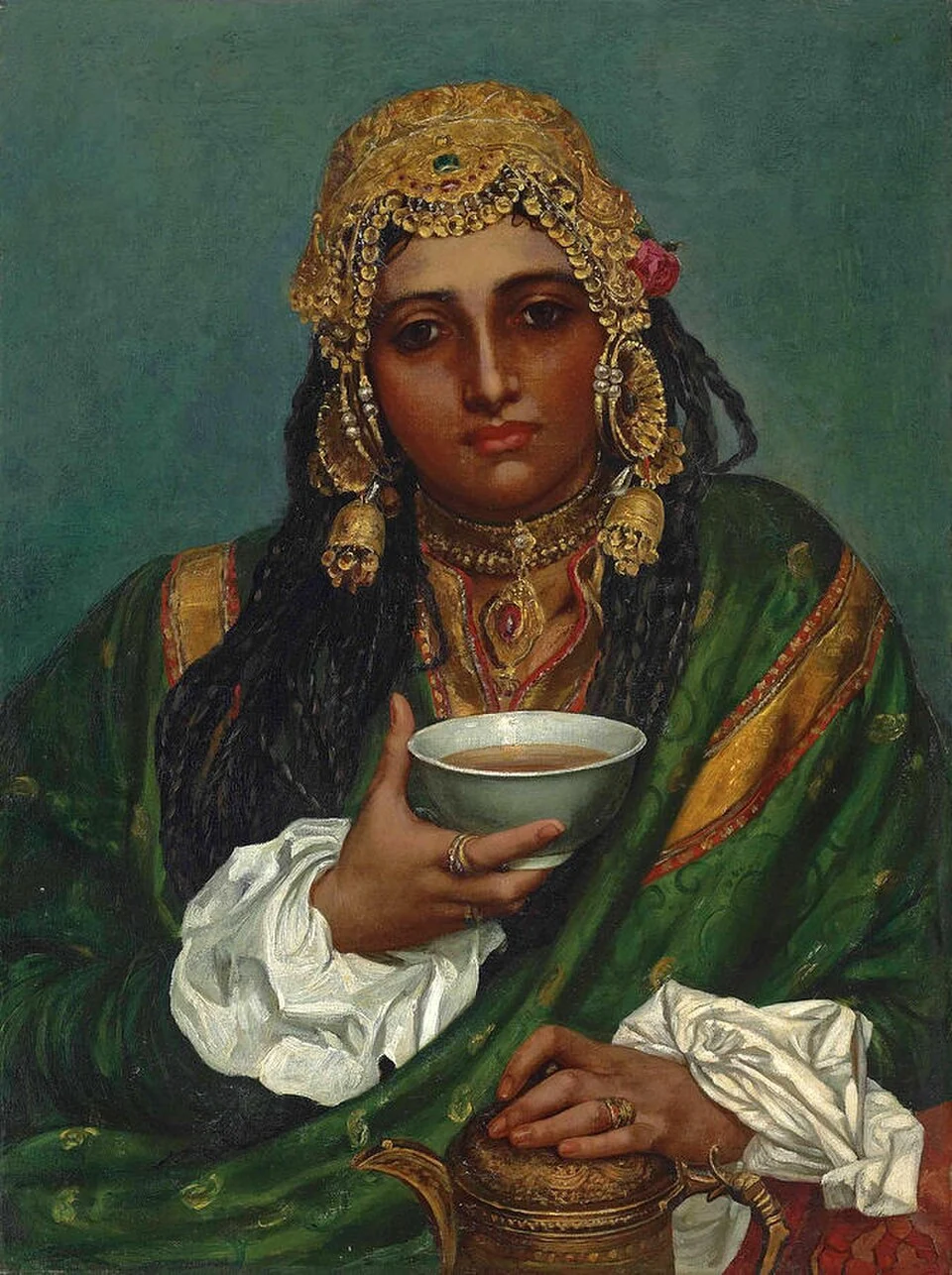
The accompanying historical artistic representation is not a documentary likeness made from a photographic sitting. Its artist and date belong in the caption, allowing the reader to distinguish the imagined poet from the surviving literary tradition.
Compare Lal Ded and Sheikh Noor-ud-din as different Kashmiri poetic voices. Pampore supplies a separate southern-valley place entry. These connections do not establish an exact birthplace or prove every biographical tradition. The Srinagar context marker locates the wider literary setting rather than an authenticated house, tomb or performance venue.
Image and map record
Image: Valentine Cameron Prinsep via Wikimedia Commons. Licence: CC0. Recorded capture date: 1880-01-01. Resized and converted to WebP; image content unchanged. This is a dated view, not confirmation of the site’s present appearance.

Map marker: 34.083, 74.797. Editorial regional-context marker. This biography, craft or cultural tradition is not a single physical destination. The point is not a verified birthplace, residence, workshop, exclusive origin, performance venue or cultural boundary. View location on OpenStreetMap · View Google Maps · Google directions · OpenStreetMap directions.
Research checked: 14 October 2026. For a visit, confirm current access, transport and opening information with the relevant authorities. This encyclopedia profile provides geographical and historical context.
Sources & references
[1] Reference overview: Habba Khatoon
https://en.wikipedia.org/wiki/Habba_Khatoon ↗
[2] Census of India: Pulwama district handbook, historical and cultural context
Image and licence
https://commons.wikimedia.org/wiki/File:Painting_of_Habba_Khatoon_by_Valentine_Cameron_Princep.jpg ↗
Related reading

Aali Masjid: Open Ground and a Historic Srinagar Mosque
Aali Masjid, also written Ali Masjid, is a historic mosque in Srinagar's Eidgah area.
Agha Shahid Ali: Poetry, Memory and Kashmir
Agha Shahid Ali was a Kashmiri-American poet who lived from 1949 to 2001. Born in New Delhi and raised in a family associated with Kashmir, he develop

Amar Singh College: Education, Campus Heritage and Institutional Change
The growth of an educational institution from a technical institute, with campus conservation and academic resources.