
Lal Ded: Voice, Vakh and Kashmir’s Literary Memory
Lal Ded, also known as Lalleshwari or Lalla, is a major figure in Kashmir's spiritual and literary memory. Usually placed in the fourteenth century, she is associated with short Kashmiri verses called vakhs. Her remembered voice has circulated across generations, making her both a literary subject and a figure of continuing cultural interpretation.
Lal Ded, also known as Lalleshwari or Lalla, is a major figure in Kashmir's spiritual and literary memory. Usually placed in the fourteenth century, she is associated with short Kashmiri verses called vakhs. Her remembered voice has circulated across generations, making her both a literary subject and a figure of continuing cultural interpretation.[1]
The vakh and its voice
Reference accounts place Lal Ded in the Kashmir Shaiva philosophical setting and identify her verse among the early landmarks of Kashmiri literature. The compact form gives particular weight to an image, question or turn of thought. A translation should therefore be identified by its translator and edition rather than presented as a word-for-word equivalence without explanation.[1]
Jai Lal Kaul's Lal Ded, published by Sahitya Akademi, is a substantial modern study of her life and poetry. Such scholarship helps distinguish the transmitted verses from stories told about their author. Biography and literary attribution are related questions, but they do not always rest on the same evidence.[2]
Memory and performance
A saint's remembered life may include teaching stories and miraculous episodes. Those narratives can be important cultural evidence without becoming independently verified events. Keeping their status visible allows a reader to understand both devotion and historical uncertainty.
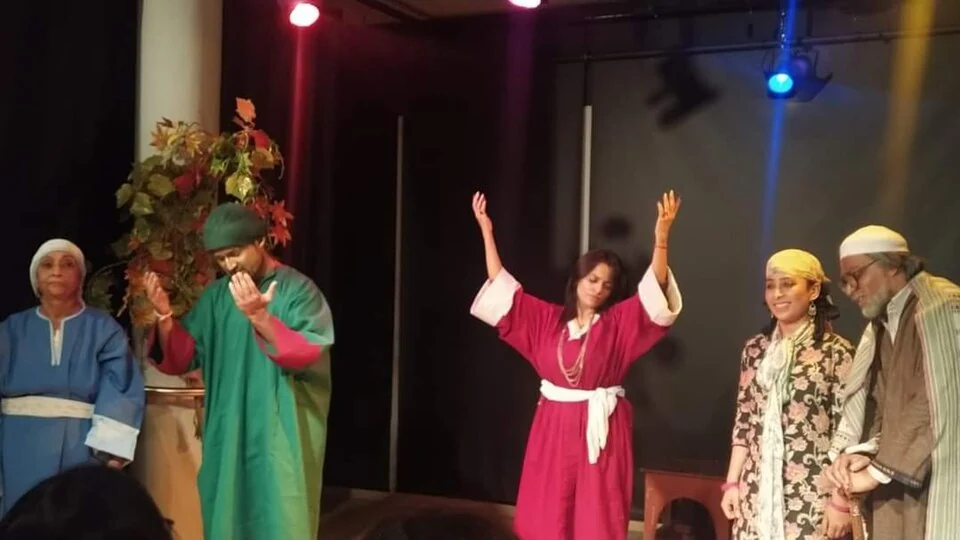
Modern theatre also interprets Lal Ded. The National School of Drama's festival record identifies a performance based on the fourteenth-century mystic. A contemporary actor's portrayal is evidence of her continuing reception, not a documentary image of the medieval person.[3]
Read Sheikh Noor-ud-din for another foundational voice in Kashmiri spiritual poetry and Habba Khatoon for a later lyric tradition. Kashmiri Language explains the distinction between a language and its written forms. These connections invite comparison without collapsing several poets into one biography. The map is a regional context point; it does not claim to identify a securely established birthplace or a preserved medieval home.
Image and map record
Image: Sukh1810 via Wikimedia Commons. Licence: CC BY-SA 4.0. Recorded capture date: 2023-03-25. Resized and converted to WebP; image content unchanged. This is a dated view, not confirmation of the site’s present appearance.
_A_Poetess_from_Kashmir.jpg)
Map marker: 34.083, 74.797. Editorial regional-context marker. This biography, craft or cultural tradition is not a single physical destination. The point is not a verified birthplace, residence, workshop, exclusive origin, performance venue or cultural boundary. View location on OpenStreetMap · View Google Maps · Google directions · OpenStreetMap directions.
Research checked: 14 October 2026. For a visit, confirm current access, transport and opening information with the relevant authorities. This encyclopedia profile provides geographical and historical context.
Sources & references
[1] Reference overview: Lalleshwari
https://en.wikipedia.org/wiki/Lalleshwari ↗
[2] Jai Lal Kaul, Lal Ded, Sahitya Akademi, 1973: bibliographic record
https://books.google.com/books/about/Lal_Ded.html?id=_vQQAAAAMAAJ ↗
[3] National School of Drama: Lal Ded production record
https://www.brm.nsd.gov.in/event/lal-ded/ ↗
Image and licence
https://commons.wikimedia.org/wiki/File:Lalleshwari_(Lall_Dyadh)_A_Poetess_from_Kashmir.jpg ↗
Related reading

Aali Masjid: Open Ground and a Historic Srinagar Mosque
Aali Masjid, also written Ali Masjid, is a historic mosque in Srinagar's Eidgah area.

Agha Shahid Ali: Poetry, Memory and Kashmir
Agha Shahid Ali was a Kashmiri-American poet who lived from 1949 to 2001. Born in New Delhi and raised in a family associated with Kashmir, he develop

Amar Singh College: Education, Campus Heritage and Institutional Change
The growth of an educational institution from a technical institute, with campus conservation and academic resources.