
Hemis Monastery: Drukpa Heritage, Courtyard and Festival Traditions
Hemis as a living Buddhist institution, with royal associations, sacred art, courtyard use and the religious meanings of its annual festival.
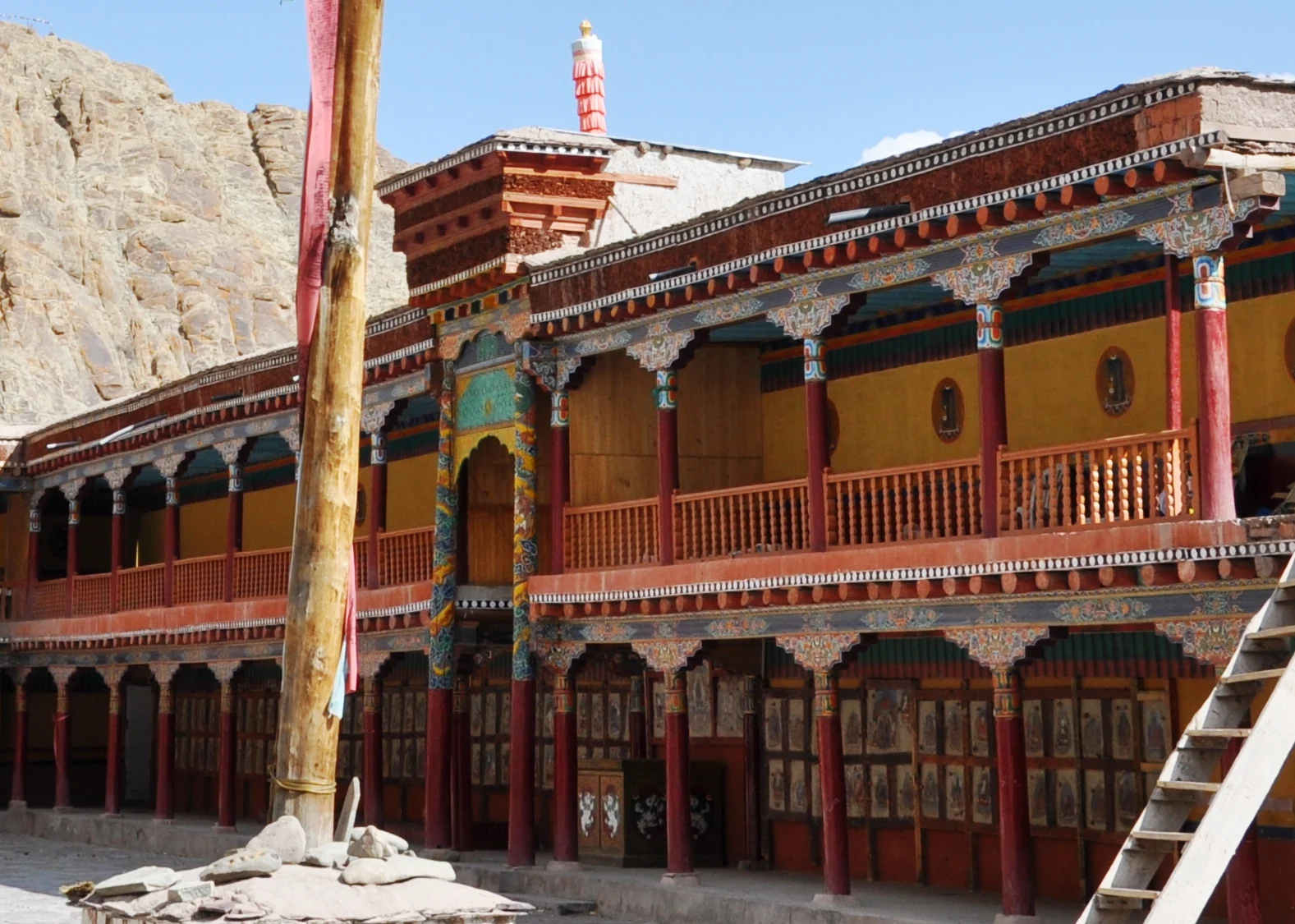
Hemis Monastery is a Buddhist monastic institution in Ladakh’s Leh district, associated with the Drukpa Kagyu tradition. Its religious identity, monastic community, sacred art and annual festival are closely connected. The monastery is therefore more than a building to be viewed from outside: it is a place where teaching, worship and ritual performance give architectural spaces their purpose. The Drukpa community’s own account identifies Hemis as an important regional seat and relates it to training for other royal monasteries.[1]
A seventeenth-century foundation, with differing dates
Accounts of Hemis commonly connect its development with royal patronage under Sengge Namgyal and the teacher Stagsang Raspa. The Ministry of Tourism’s monastic overview gives a foundation date of 1630, while the Indira Gandhi National Centre for the Arts festival account gives 1672. The Drukpa institutional description uses the broader seventeenth-century period. These sources support the historical association, but do not resolve every detail into one universally agreed year.[1][2]
This entry therefore treats the seventeenth century as the secure general frame and preserves the differing published dates. A claim of earlier origins, a later rebuilding and the establishment of an institution may refer to different events. They should not be collapsed into a single construction date without a clear historical argument. The same care is needed when a tourism summary is used beside a religious account: each may emphasise a different part of the institution’s past.
Courtyard, halls and sacred images
The Ministry of Tourism describes Hemis through its Drukpa association, statues and mural paintings. Its monastic overview also places it in the wider Indus-side landscape southeast of Leh. The image supplied with this article shows the courtyard and its surrounding architecture, with painted surfaces, balconies and a ceremonial pole visible. The photograph’s 2011 date is retained because a historic view cannot establish the present condition of every surface or room.[2]
A courtyard is an architectural space, but at Hemis its importance also comes from how it is used. The festival account describes a rectangular performance area in front of the monastery’s main doorway, with raised platforms and space assigned to musicians and lamas. Ritual objects, seats and the arrangement of people transform the open area into a setting for a specific ceremony. The relationship between permanent building and temporary arrangement is part of the monastery’s living heritage.[3]
Hemis Tsechu and Padmasambhava
The district’s festival guide identifies Hemis Tsechu as a summer monastic festival dedicated to Padmasambhava, also known as Guru Rinpoche. Its general calendar places the event around June or early July. This is a seasonal guide, not a reliable date for booking a visit in an unspecified year. The festival follows religious calendrical arrangements, and the monastery or current district announcement should be consulted for the date of a particular observance.[4]
The same district account describes monastic festivals as gatherings for people from surrounding communities, bringing worship together with meeting friends and the atmosphere of a shared occasion. This social dimension should be read alongside the ritual one. A public audience does not make the ceremony merely a show, and a visitor’s experience is only one perspective on an event with religious meaning for its participants.[4]
IGNCA’s account describes the masked dances collectively as chams and connects them with Vajrayana ritual traditions. Masks and costumes represent meditative or protective figures, while music and prescribed movements form part of the performance. The account discusses victory over harmful forces and the protection of Buddhist teaching as religious meanings expressed by the ceremony. These are beliefs and ritual interpretations, rather than claims that an encyclopedia can verify as physical outcomes.[3]
Art, observation and the monastery’s wider setting
The secondary monastery reference records paintings of the eighty-four Mahasiddhas around the courtyard. Such an account gives readers a way to distinguish a specific cycle of sacred images from a general description of “colourful decoration”. Individual paintings need their own iconographic identification, condition record and provenance. The article introduces that subject without pretending to catalogue every image in the complex.[5]
Hemis Monastery and Hemis National Park are separate subjects despite their shared name. A monastery is a religious institution; the park is a protected landscape. The district maintains a distinct national-park entry. Searching by the word Hemis alone can therefore lead to different kinds of information, and an encyclopedia should make the difference clear through titles, categories and location descriptions.[6]
For another relationship between patronage and architecture in Ladakh, read Leh Palace. Kargil district introduces a wider regional history of settlement and trade. Comparisons with Jamia Masjid, Srinagar and Raghunath Temple, Jammu should retain each institution’s own religious tradition rather than treating all sacred buildings as one interchangeable category.
Photograph and map record
Photograph: Prof Ranga Sai via Wikimedia Commons. Licence: CC BY-SA 4.0. Recorded capture date: 2011-11-01 12:19. Resized and converted to WebP; scene content unchanged. This is a dated view, not confirmation of the site’s present appearance.

Map marker: 33.912475, 77.702833. Monastery locator from the secondary geographical reference; not a surveyed boundary or a verified accessible entrance. View location on OpenStreetMap · View Google Maps · Google directions · OpenStreetMap directions.
Research checked: 14 October 2026. For a visit, confirm current access, transport and opening information with the relevant authorities. This encyclopedia profile provides geographical and historical context.
Sources & references
[1] Drukpa Humanitaire — Hemis institutional account
https://www.drukpahumanitaire.org/english/other_mons.htm ↗
[2] Ministry of Tourism — Monasteries in Ladakh
https://www.incredibleindia.gov.in/en/ladakh/leh/monasteries-in-ladakh ↗
[3] Indira Gandhi National Centre for the Arts — The Hemis Festival
https://ignca.gov.in/the-hemis-festival/ ↗
[4] District Leh — Festivals
https://leh.nic.in/tourism/festivals/ ↗
[5] Hemis Monastery — Secondary art and coordinate reference
https://en.wikipedia.org/wiki/Hemis_Monastery ↗
[6] District Leh — Hemis National Park, a separate place
https://leh.nic.in/tourist-place/hemis-national-park/ ↗
Photograph and licence
https://commons.wikimedia.org/wiki/File:Hemis_Monastery_courtyard.jpg ↗
Related reading
Leh Palace: Namgyal Kingship and Himalayan Building Traditions
Leh Palace’s royal history, vertical organisation, earth-and-timber construction and relationship to Leh’s historic townscape.