
Gurdwara Pathar Sahib: Sikh Tradition in the Indus Valley
Gurdwara Pathar Sahib is a Sikh place of worship in the Indus-valley corridor west of Leh.
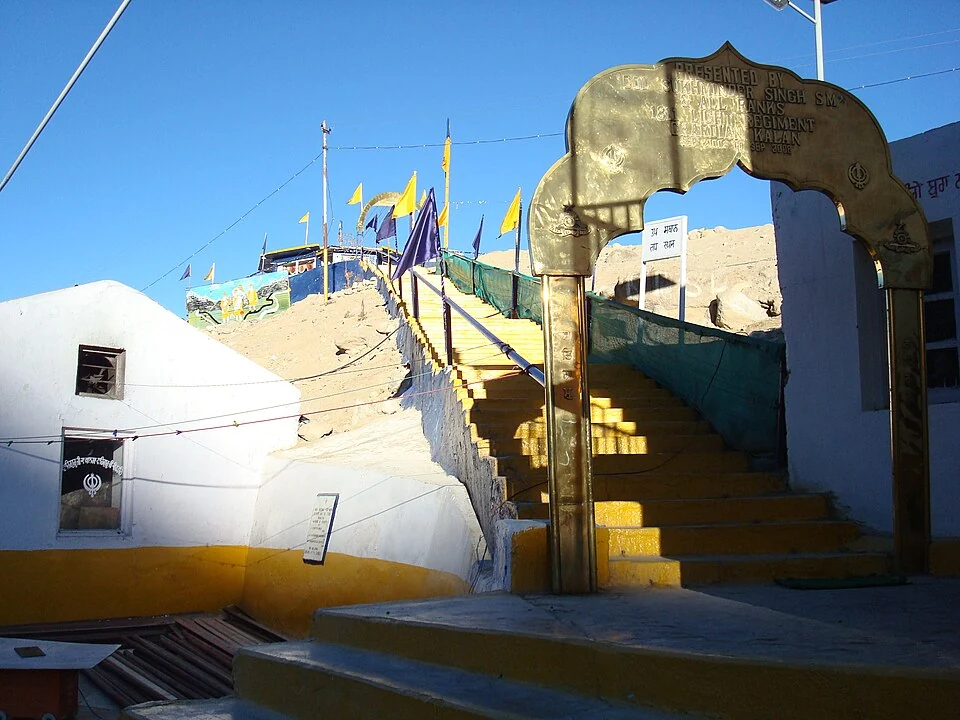
Gurdwara Pathar Sahib is a Sikh place of worship in the Indus-valley corridor west of Leh. It is associated with a tradition concerning Guru Nanak and a revered boulder. The sacred narrative, the material object and the present buildings should be identified separately, even though they are central parts of one devotional place.[1]
Tradition and a sacred object
The national tourism description recounts the Guru Nanak tradition associated with the site. Such accounts explain its religious meaning and should be introduced as traditions rather than used as geological explanations for the boulder's form. Devotional significance does not require presenting a miracle narrative as an independently measured physical event.[2]
The gurdwara belongs to a wider landscape of roads, settlements and religious institutions in Ladakh. Its Sikh identity should remain clear while recognising that the surrounding region includes other traditions. A photograph of the entrance shows a particular part of the complex, not all of its rooms or services.[1]
A place of worship and hospitality
Gurdwaras are associated with worship and practices of hospitality, but current arrangements at an individual site should be confirmed locally. An encyclopedia profile can explain the institution without guaranteeing that a particular meal, accommodation or transport service will be available at the time of a visit.
The name Pathar Sahib has variant spellings in maps and references. A stable subject record and location help readers distinguish this Ladakh site from similarly named places elsewhere. Directions should identify the intended complex rather than rely on a name alone.
Compare Chatti Padshahi in Srinagar for another regional Sikh institution, and Spituk for a separate Buddhist site near Leh. Khaltse provides an Indus-corridor settlement context. These entries explain religious and geographical relationships without treating them as one shared foundation history or a guaranteed visitor circuit.
A sacred place may retain its identity while buildings and visitor facilities change, making dated accounts especially useful for historical comparison.
Photograph and map record
Photograph: Goutam1962 via Wikimedia Commons. Licence: CC BY-SA 4.0. Recorded capture date: 2014-02-01 08:27:28. Resized and converted to WebP; scene content unchanged. This is a dated view, not confirmation of the site’s present appearance.

Map marker: 34.191967, 77.375617. Source-recorded camera-location point at Pathar Sahib, not a verified public vehicle entrance. View location on OpenStreetMap · View Google Maps · Google directions · OpenStreetMap directions.
Research checked: 14 October 2026. For a visit, confirm current access, transport and opening information with the relevant authorities. This encyclopedia profile provides geographical and historical context.
Sources & references
[1] Gurdwara Patthar Sahib — secondary historical/geographical overview
https://en.wikipedia.org/wiki/Gurdwara_Patthar_Sahib ↗
[2] Ministry of Tourism: Pathar Sahib tradition and sacred site
https://www.incredibleindia.gov.in/en/ladakh/leh/gurudwara-pathar-sahib ↗
Photograph and licence
https://commons.wikimedia.org/wiki/File:Pathar_sahib_Gurudwara_1.jpg ↗
Related reading
Gurdwara Chatti Padshahi: Sikh Heritage at Hari Parbat
A Sikh institution commemorating Guru Hargobind near Kathi Darwaza in Rainawari.
Hemis Monastery: Drukpa Heritage, Courtyard and Festival Traditions
Hemis as a living Buddhist institution, with royal associations, sacred art, courtyard use and the religious meanings of its annual festival.
Ice Hockey in Ladakh: Winter Sport and Community Participation
Ice hockey in Ladakh connects winter recreation, competitive sport and community participation.