
Zain-ul-Abidin: Kingship and Cultural Patronage in Kashmir
Zain-ul-Abidin, often remembered by the title Budshah, was a fifteenth-century sultan of Kashmir. His reign is associated with cultural patronage, craft activity and a comparatively accommodating approach to religious communities. The remembered title expresses a favourable historical reputation; particular claims about policy still need their own evidence.
Zain-ul-Abidin, often remembered by the title Budshah, was a fifteenth-century sultan of Kashmir. His reign is associated with cultural patronage, craft activity and a comparatively accommodating approach to religious communities. The remembered title expresses a favourable historical reputation; particular claims about policy still need their own evidence.[1]
Rule and reputation
Historical accounts place his principal reign in the period 1420–1470. Discussions of his government connect administration with the encouragement of crafts and learning. A ruler's patronage can create opportunities for production without making the ruler the sole inventor of an entire craft tradition.[1]
A research article by Mehjabeen Akhter examines the sultan's political and cultural role. Its account is a modern historical interpretation, which should be read alongside the sources it cites. Praise in a later study and a dated record of an administrative measure are different forms of evidence.[2]
Patronage in a working landscape
Craft history depends on artisans, materials, training and exchange as well as court support. Understanding a patron therefore means asking what was encouraged, how people worked and what evidence survives. A general statement about flourishing arts should not be expanded into an unsupported founding date for every present workshop.
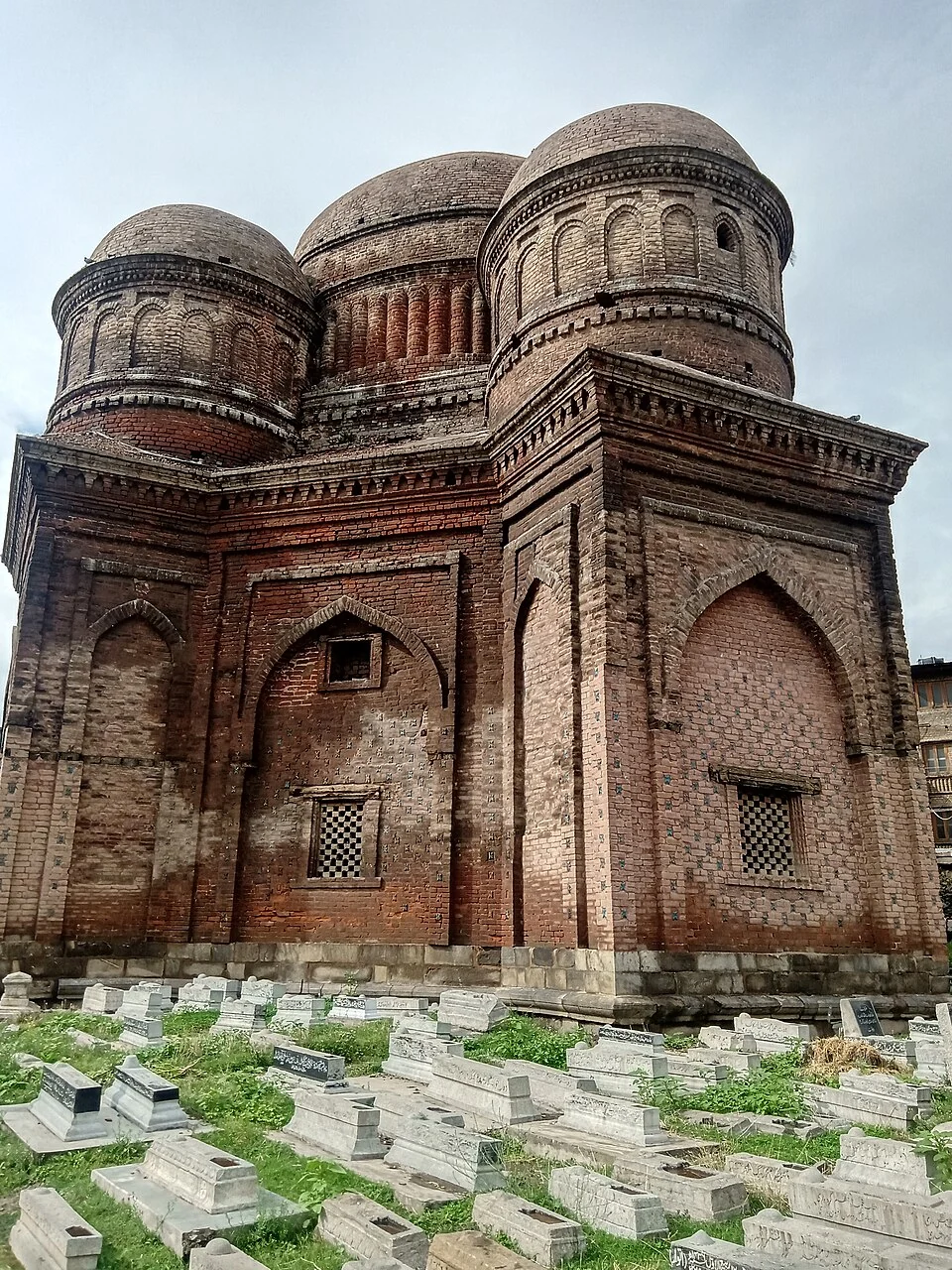
Built monuments provide another route into the period. The Archaeological Survey of India's monument list includes the tomb of Zain-ul-Abidin's mother near Zaina Kadal in Srinagar. A monument associated with a ruler's family is not necessarily that ruler's own tomb, and a caption should preserve that distinction.[3]
Read Kashmir Papier-mâché and Kashmir Carpets for separate craft histories. Aali Masjid supplies a built-heritage comparison from medieval Srinagar. Linking these entries helps readers investigate patronage without assuming that every surviving structure or technique has an unchanged fifteenth-century form. The map is a Srinagar historical-context marker, not a surveyed royal residence or a claim about the precise extent of his kingdom.
Image and map record
Image: Prithvi-1960 via Wikimedia Commons. Licence: CC BY-SA 4.0. Recorded capture date: 2022-07-28 16:20:24. Resized and converted to WebP; image content unchanged. This is a dated view, not confirmation of the site’s present appearance.

Map marker: 34.083, 74.797. Editorial regional-context marker. This biography, craft or cultural tradition is not a single physical destination. The point is not a verified birthplace, residence, workshop, exclusive origin, performance venue or cultural boundary. View location on OpenStreetMap · View Google Maps · Google directions · OpenStreetMap directions.
Research checked: 14 October 2026. For a visit, confirm current access, transport and opening information with the relevant authorities. This encyclopedia profile provides geographical and historical context.
Sources & references
[1] Reference overview: Zayn al-Abidin the Great
https://en.wikipedia.org/wiki/Zayn_al-Abidin_the_Great ↗
[2] Mehjabeen Akhter, Zain-ul-Abidin — the Great Sultan of Kashmir, 2017
https://ijcrt.org/viewfull.php?p_id=IJCRT1704170 ↗
[3] Archaeological Survey of India: centrally protected monument list
https://asi.nic.in/pdf/CPM_List.pdf ↗
Image and licence
https://commons.wikimedia.org/wiki/File:Tomb_of_Zain-ul-Abidin%27s_mother.jpg ↗
Related reading

Aali Masjid: Open Ground and a Historic Srinagar Mosque
Aali Masjid, also written Ali Masjid, is a historic mosque in Srinagar's Eidgah area.

Agha Shahid Ali: Poetry, Memory and Kashmir
Agha Shahid Ali was a Kashmiri-American poet who lived from 1949 to 2001. Born in New Delhi and raised in a family associated with Kashmir, he develop

Amar Singh College: Education, Campus Heritage and Institutional Change
The growth of an educational institution from a technical institute, with campus conservation and academic resources.