
Kashmir Carpets: Knots, Design and Artisan Work
Kashmir's hand-knotted carpets combine a woven foundation, a knotted pile and a planned design.
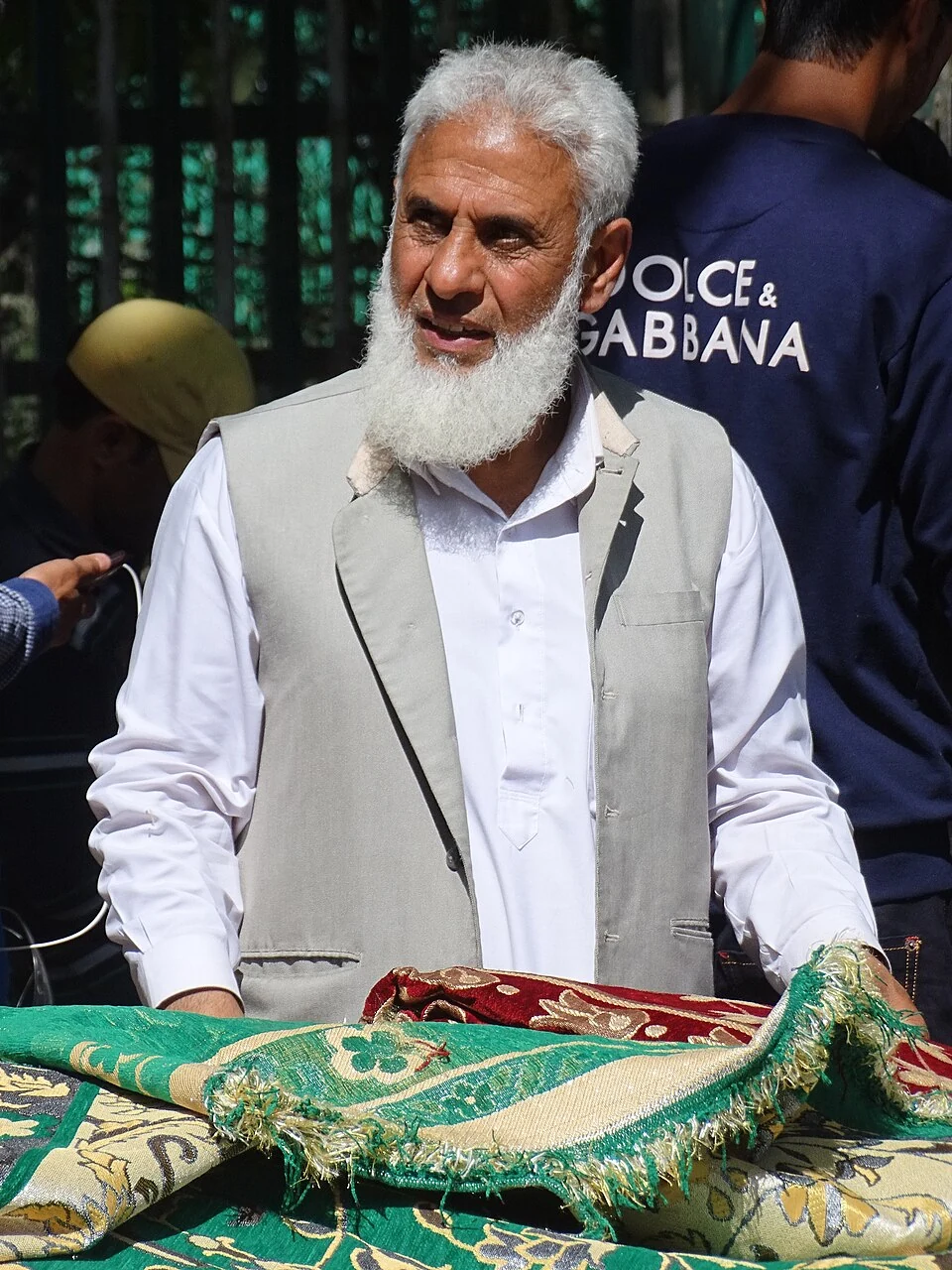
Kashmir's hand-knotted carpets combine a woven foundation, a knotted pile and a planned design. Wool and silk are associated with different examples, while material, knotting and pattern must be identified separately. A soft surface or a familiar floral design does not by itself establish that a carpet was made in Kashmir. Provenance depends on the object and its production record.[1]
Design translated into work
The national handicrafts directory recognises Kashmiri hand-knotted carpet as a regional craft. Its making links design with repeated, skilled operations on a loom. The talim system of design instructions is associated with the tradition: a pattern is translated into a sequence that can guide work rather than being copied only by eye.[2]
The completed carpet can be read at several scales. From a distance, a central field and borders organise the composition. Closer inspection shows knots, colour transitions and the treatment of repeated motifs. A detailed surface does not reveal every decision made in producing the foundation, preparing yarn or finishing the object.
Material, workmanship and provenance
GI records and craft institutions provide a basis for investigating regional identity. The carpet institution in Srinagar identifies the craft within Kashmir's registered GI traditions. A general association with a GI name is different from proof that an individual product meets its conditions; buyers need the actual maker, material and identification record.[3]
A useful object description records dimensions, fibre, knot structure, condition and maker where known. Terms such as “silk,” “handmade” and “Kashmiri” answer different questions and should not be collapsed into one quality label. Repairs and changes to an older carpet also belong in its history.
Compare Pashmina for another textile subject and Papier-mâché for a contrasting decorative craft. The SPS Museum entry explains why objects can be studied through collections as well as markets. The context marker here locates Srinagar's craft setting, not every workshop producing a carpet.
Photograph and map record
Photograph: Adam Jones from Kelowna, BC, Canada via Wikimedia Commons. Licence: CC BY-SA 2.0. Recorded capture date: 2016-05-01 02:34. Resized and converted to WebP; scene content unchanged. This is a dated view, not confirmation of the site’s present appearance.
.jpg)
Map marker: 34.083, 74.797. Editorial regional-context marker for Srinagar. This subject is not a single physical destination: the point is not a birthplace, workshop, harvest site, species range, guaranteed wildlife locality or boundary of language use. View location on OpenStreetMap · View Google Maps · Google directions · OpenStreetMap directions.
Research checked: 14 October 2026. For a visit, confirm current access, transport and opening information with the relevant authorities. This encyclopedia profile provides geographical and historical context.
Sources & references
[1] Kashmir rug — secondary historical/geographical overview
https://en.wikipedia.org/wiki/Kashmir_rug ↗
[2] Development Commissioner Handicrafts: Kashmiri hand-knotted carpet
[3] IICT Srinagar: regional GI crafts
https://iictsrinagarcarpet-gi.org/gi-crafts ↗
Photograph and licence
Related reading

Aali Masjid: Open Ground and a Historic Srinagar Mosque
Aali Masjid, also written Ali Masjid, is a historic mosque in Srinagar's Eidgah area.

Amar Singh College: Education, Campus Heritage and Institutional Change
The growth of an educational institution from a technical institute, with campus conservation and academic resources.
Bakshi Stadium: Football and a Public Sports Venue in Srinagar
Bakshi Stadium is a major sports venue in Srinagar, particularly associated with football.