
Holy Family Catholic Church: A Parish in Srinagar’s Religious Landscape
The Catholic parish’s institutional history, rebuilding and documented 2017 bell ceremony.
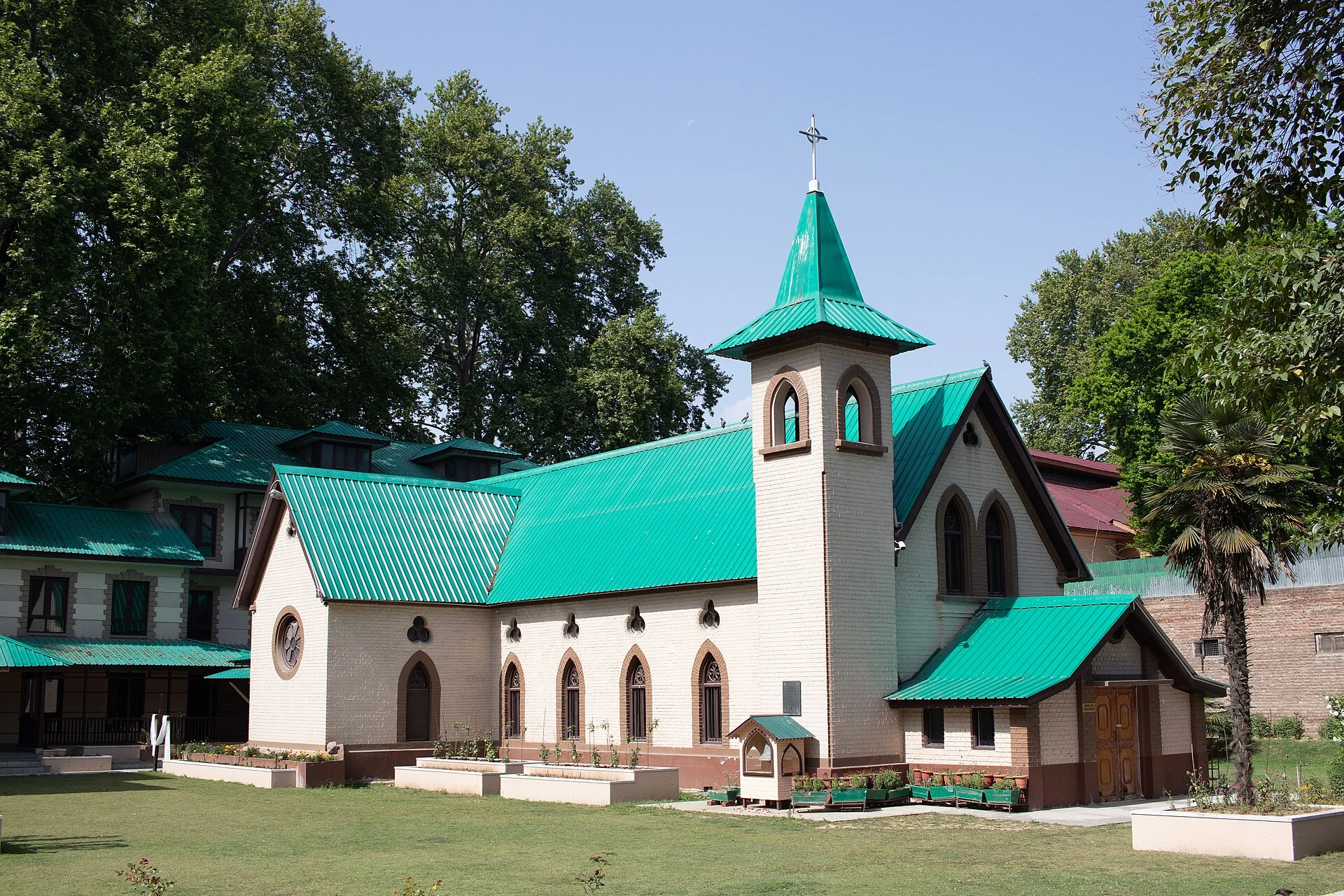
Holy Family Catholic Church is a Roman Catholic parish church on Maulana Azad Road in Srinagar. Its history belongs to the smaller Christian presence within a city better known through other religious landmarks. The secondary church reference dates its establishment to 1896 and associates it with Msgr. Winkley of the Mill Hill missionaries. The church’s name, denomination and street location distinguish it from Srinagar’s Protestant churches.[2]
A parish within a wider diocese
The Diocese of Jammu–Srinagar’s historical account describes the growth of Catholic institutions in the region and the establishment of the diocese in 1986. The church reference records Holy Family’s earlier cathedral role while the church administration was based in Srinagar. A parish church and a cathedral are different institutional descriptions: the latter refers to the bishop’s seat rather than simply to a building’s size or age.[1][2]
That distinction helps explain changes in role without suggesting that the parish ceased to matter when administrative arrangements changed. The building remained connected with a worshipping community in Srinagar. Its institutional history can therefore be followed alongside the larger diocesan history without treating the two as identical narratives.
Damage, reconstruction and the bell
The secondary account records fire damage in 1967, the rebuilding of the church and the loss of its earlier belfry. These events mean that a long-established parish should not be described as a completely unchanged nineteenth-century structure. Continuity of the institution can coexist with replacement and restoration of its fabric.[2]
Associated Press reporting, published by Voice of America in October 2017, documented the installation and ringing of a new bell after about five decades. Representatives of Christian, Muslim, Hindu and Sikh communities participated in the occasion. The report records a particular event with a clear date; it provides stronger evidence for that moment than an undated general statement about the church’s social role.[3]
The new bell had religious and public significance. It marked renewed sound at a place where the earlier bell had been lost, while the shared ceremony made that renewal visible to neighbouring communities. The historical event should remain distinct from ordinary parish worship or an assumption that similar ceremonies take place on every visit.
The building in its city setting
The photograph shows the church exterior and its green-roofed tower within the street-side precinct. The view records a building of modest scale rather than a monumental enclosure dominating a hill or riverbank. Its architectural presence is one part of a city in which different religious institutions are encountered at very different scales.
The church’s current service times and internal arrangements should be checked through the parish or diocese. A dated image and a historical report do not establish whether particular spaces are open to casual visitors on a chosen day. The map point identifies the church, while the photograph credit records its source and capture date.
Compare Chatti Padshahi Gurdwara for another living community institution and Jamia Masjid for a different architectural scale. Charar-e-Sharief also illustrates the distinction between the continuity of a religious place and the rebuilding of its structures.
Photograph and map record
Photograph: Philsgr via Wikimedia Commons. Licence: CC BY-SA 4.0. Recorded capture date: 2019-04-27. Resized and converted to WebP; scene content unchanged. This is a dated view, not confirmation of the site’s present appearance.

Map marker: 34.07455, 74.818997. Representative coordinate from the secondary geographical reference; not a surveyed boundary or a verified accessible entrance. View location on OpenStreetMap · View Google Maps · Google directions · OpenStreetMap directions.
Research checked: 14 October 2026. For a visit, confirm current access, transport and opening information with the relevant authorities. This encyclopedia profile provides geographical and historical context.
Sources & references
[1] Primary place or institutional account
https://www.jammusrinagardiocese.org/pages/history ↗
[2] Secondary historical and geographical reference
https://en.wikipedia.org/wiki/Holy_Family_Catholic_Church_%28Srinagar%29 ↗
[3] Associated Press via VOA — Bell ceremony, 29 October 2017
https://www.voanews.com/a/church-bell-rings-in-kashmir-church/4091026.html ↗
Photograph and licence
https://commons.wikimedia.org/wiki/File:Holy_Family_Catholic_Church_Srinagar.jpg ↗
Related reading

Aali Masjid: Open Ground and a Historic Srinagar Mosque
Aali Masjid, also written Ali Masjid, is a historic mosque in Srinagar's Eidgah area.

Amar Singh College: Education, Campus Heritage and Institutional Change
The growth of an educational institution from a technical institute, with campus conservation and academic resources.
Bakshi Stadium: Football and a Public Sports Venue in Srinagar
Bakshi Stadium is a major sports venue in Srinagar, particularly associated with football.