
Rouf: Group Dance and Song in Kashmir
Rouf, also spelled rauf, is a group dance associated with Kashmir. It is especially recognised through women dancing together in coordinated rows while singing. The visual pattern of linked movement and the sound of shared song make the group, rather than an isolated solo performer, central to the form.
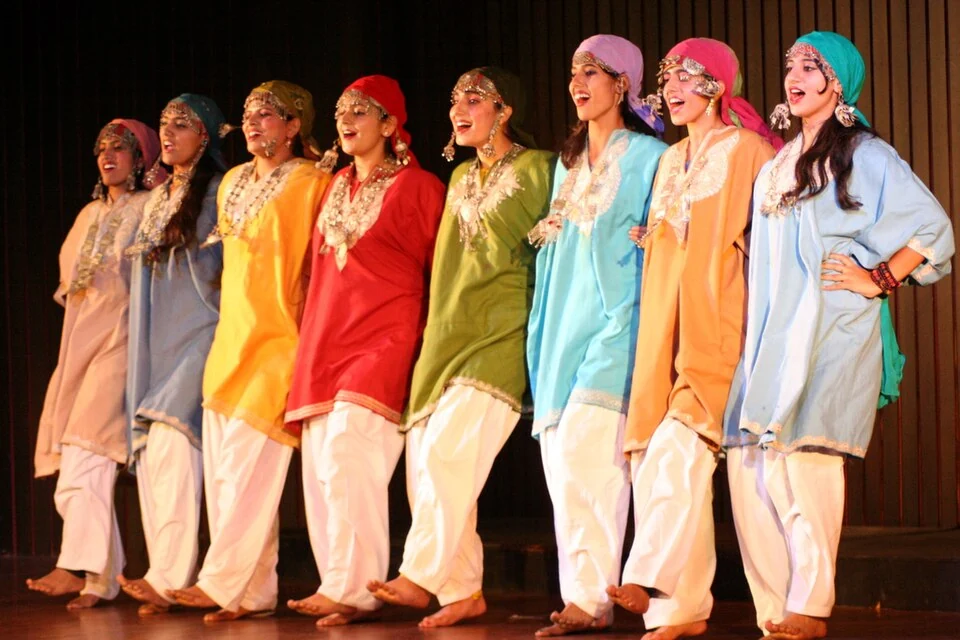
Rouf, also spelled rauf, is a group dance associated with Kashmir. It is especially recognised through women dancing together in coordinated rows while singing. The visual pattern of linked movement and the sound of shared song make the group, rather than an isolated solo performer, central to the form.[1]
Movement and occasion
The Jammu and Kashmir Tourist Development Corporation identifies Rouf among Kashmir's familiar dance traditions and associates it with the arrival of spring. Its account also notes variations in pronunciation. A written English spelling therefore supplies a search term, while the spoken name can sound different in different settings.[2]
Descriptions of Rouf emphasise facing rows, coordinated footwork and collective singing. These features explain the relationship between performers: the timing of one dancer depends on the timing of others. A photograph shows the arrangement at one instant; the repeated shifts and responses become clearer in a complete performance record.[1]
A living performance
Costume is part of the presentation, but it does not define the whole dance. The formation, song and coordination remain important even when colours or fabrics change. A staged cultural programme may emphasise uniform dress, whereas a community gathering can have a different visual character.
Performance documentation is most useful when it names the occasion, performers and date. Those details let readers distinguish a rehearsal from a celebration or a shortened stage demonstration. They also acknowledge the people maintaining the tradition instead of treating a dance as an anonymous decorative image.
Compare Dumhal, a different ceremonial tradition, and Bhand Pather, which combines dramatic action with performance. Pheran provides a separate clothing entry. These links clarify related cultural subjects without suggesting that the dance forms use the same performers, occasions or movement vocabulary. The Srinagar marker supplies regional orientation; Rouf is not a single venue or a scheduled show guaranteed to take place at that point.
Image and map record
Image: Ramesh Lalwani via Wikimedia Commons. Licence: CC BY 2.0. Recorded capture date: 2011-12-02 18:18:41. Resized and converted to WebP; image content unchanged. This is a dated view, not confirmation of the site’s present appearance.

Map marker: 34.083, 74.797. Editorial regional-context marker. This biography, craft or cultural tradition is not a single physical destination. The point is not a verified birthplace, residence, workshop, exclusive origin, performance venue or cultural boundary. View location on OpenStreetMap · View Google Maps · Google directions · OpenStreetMap directions.
Research checked: 14 October 2026. For a visit, confirm current access, transport and opening information with the relevant authorities. This encyclopedia profile provides geographical and historical context.
Sources & references
[1] INTACH: Folk Dances of India — Rouf
https://youngintach.org/files/folk-dances-of-india-rouf.pdf ↗
[2] JKTDC: Dances of Kashmir
https://jktdc.co.in/info.aspx?id=101 ↗
Image and licence
Related reading

Aali Masjid: Open Ground and a Historic Srinagar Mosque
Aali Masjid, also written Ali Masjid, is a historic mosque in Srinagar's Eidgah area.
Agha Shahid Ali: Poetry, Memory and Kashmir
Agha Shahid Ali was a Kashmiri-American poet who lived from 1949 to 2001. Born in New Delhi and raised in a family associated with Kashmir, he develop

Amar Singh College: Education, Campus Heritage and Institutional Change
The growth of an educational institution from a technical institute, with campus conservation and academic resources.