
Hangul: Kashmir’s Red Deer and Its Conservation Setting
Hangul is the Kashmir red deer, a distinctive deer population closely associated with the Kashmir Valley and particularly Dachigam.
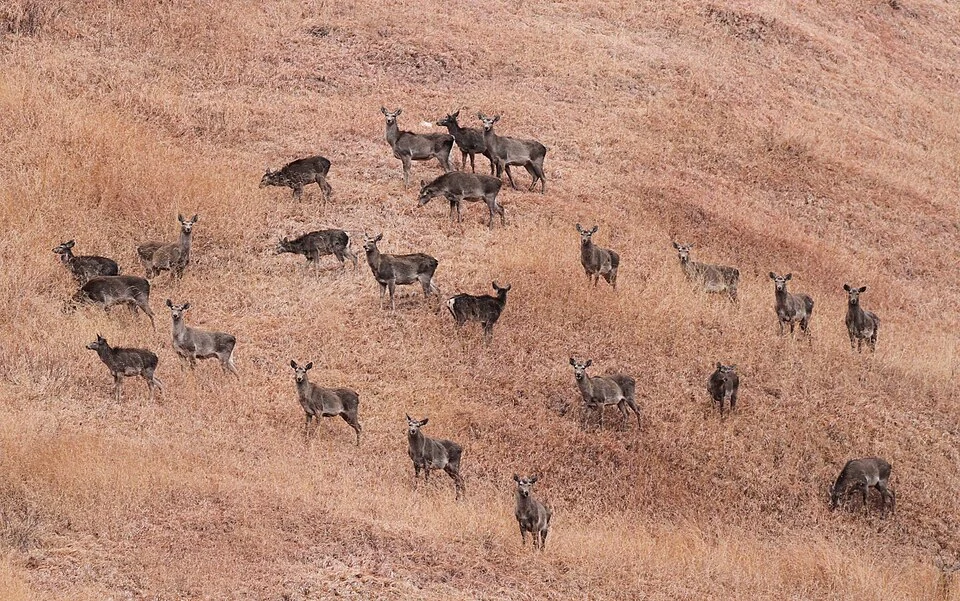
Hangul is the Kashmir red deer, a distinctive deer population closely associated with the Kashmir Valley and particularly Dachigam. The animal is recognised by its relationship with the region's forest and mountain landscape, while its taxonomic treatment has varied between reference works. A common name is therefore a useful starting point, but scientific names should be stated with the classification being followed.[1]
Animal and habitat
Male deer develop antlers, which are different from permanently retained horns. Feeding, shelter and movement link the animal with a range of vegetation and seasonal conditions. A photograph of an individual does not describe the size, sex composition or distribution of a whole population. Those questions require systematic field observation.[1]
The Wildlife Institute of India's endangered-species programme includes work on a conservation action plan for hangul. This places the animal within an evidence-based conservation setting. A programme description is not a live census, and an older count should not be repeated as the current number of deer without its date and method.[2]
Conservation through a landscape
Habitat is more than the point where a deer happens to be photographed. Seasonal food, cover and routes between areas can matter to the animal's life. Management therefore needs to consider connected ground and human activity as well as the presence of animals in a protected site.
Observation also has limits. Failure to see a deer during a brief visit does not prove absence, while seeing several together does not establish a regional population increase. Repeated counts, known survey areas and comparable methods provide a stronger basis for interpreting change. Public viewing should avoid disturbance and follow the relevant rules.
Read the Dachigam National Park entry for a specific conservation landscape and Himalayan Monal for another animal associated with mountain habitats. Hokersar provides a contrasting wetland conservation subject. The representative Dachigam marker is habitat context, not a guaranteed viewing location or a mapped limit of hangul distribution.
Photograph and map record
Photograph: Tahirshawl via Wikimedia Commons. Licence: CC BY-SA 4.0. Recorded capture date: 2016-03-05 05:46:46. Resized and converted to WebP; scene content unchanged. This is a dated view, not confirmation of the site’s present appearance.

Map marker: 34.13722, 75.03778. Dachigam habitat context only, not a guaranteed viewing point or mapped limit of hangul distribution. View location on OpenStreetMap · View Google Maps · Google directions · OpenStreetMap directions.
Research checked: 14 October 2026. For a visit, confirm current access, transport and opening information with the relevant authorities. This encyclopedia profile provides geographical and historical context.
Sources & references
[1] Kashmir stag — secondary historical/geographical overview
https://en.wikipedia.org/wiki/Kashmir_stag ↗
[2] Wildlife Institute of India: conservation research programmes
https://v1.wii.gov.in/endangeredspeciesmanagement ↗
Photograph and licence
https://commons.wikimedia.org/wiki/File:The_Last_Surviving_Population_of_Hangul.jpg ↗
Related reading

Aali Masjid: Open Ground and a Historic Srinagar Mosque
Aali Masjid, also written Ali Masjid, is a historic mosque in Srinagar's Eidgah area.

Amar Singh College: Education, Campus Heritage and Institutional Change
The growth of an educational institution from a technical institute, with campus conservation and academic resources.
Bakshi Stadium: Football and a Public Sports Venue in Srinagar
Bakshi Stadium is a major sports venue in Srinagar, particularly associated with football.