
Kashmir Walnut Wood Carving: Material, Relief and Making
Kashmir walnut wood carving is a regional craft that turns the grain and working qualities of walnut timber into decorated objects and architectural components.
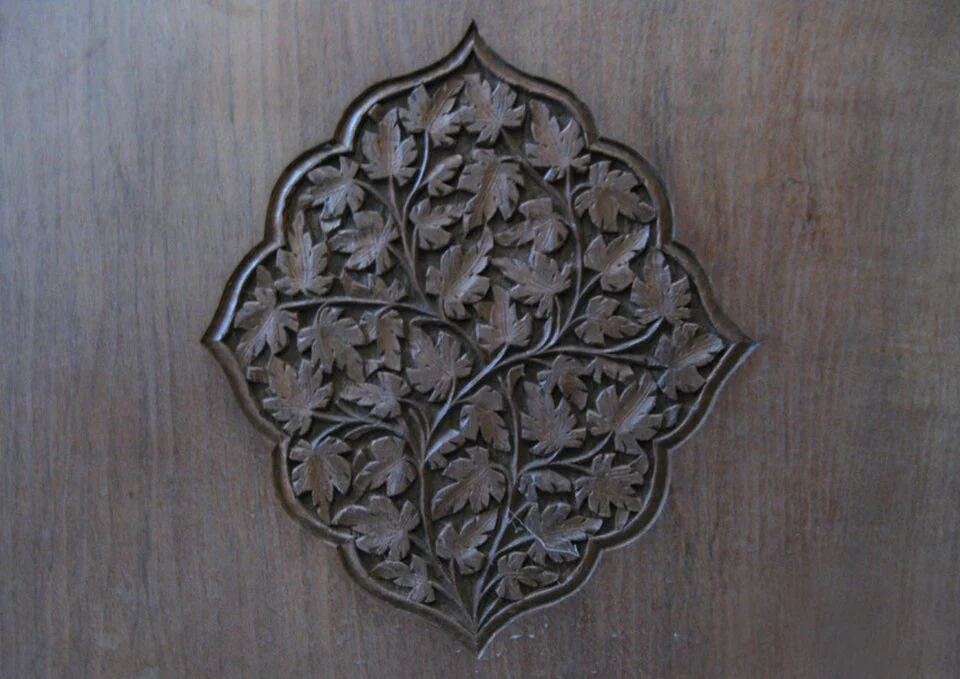
Kashmir walnut wood carving is a regional craft that turns the grain and working qualities of walnut timber into decorated objects and architectural components. Furniture, boxes and carved panels are familiar forms. The craft is not defined by a floral pattern alone: the material, carving process and provenance all contribute to the identity of an individual work.[1]
Working with the timber
The national handicrafts account identifies walnut carving among Jammu and Kashmir's GI crafts and describes influences within its decorative history. Carving removes material to create relief, recesses and patterns. The depth of work and the arrangement of motifs affect how light falls on the surface, while the wood's grain remains part of the finished appearance.[2]
A carved surface can be examined through both design and structure. Broad fields establish a composition; smaller cuts produce detail and texture. A piece of furniture also has joints, supports and surfaces that perform practical functions. Decorative complexity does not by itself tell a reader whether the object is structurally sound or how it was assembled.
Objects and provenance
The GI registry provides a specific record for Kashmir Walnut Wood Carving. It is useful for studying the recognised craft and authorised producer framework, while an individual purchase still requires its own identification. Wood species, maker and claimed place of production should be recorded rather than inferred from a dark finish.[3]
Finishing, wear and restoration can change the appearance of timber over time. Colour alone is consequently a poor guide to age, and an older-looking object is not automatically an antique. An encyclopedia can describe the craft without assigning unsupported dates to pieces whose history is unknown.
Compare Papier-mâché, where painted decoration may cover a paper-based form, and Kangri, where earthenware and wicker have a different relationship between material and use. Carpets adds a textile comparison. Each craft deserves a material-specific description rather than one generic account of “Kashmiri handicrafts.”
Photograph and map record
Photograph: Ehsan Quddusi via Wikimedia Commons. Licence: CC BY-SA 2.0. Recorded capture date: 2009-06-26 19:54:47. Resized and converted to WebP; scene content unchanged. This is a dated view, not confirmation of the site’s present appearance.

Map marker: 34.083, 74.797. Editorial regional-context marker for Srinagar. This subject is not a single physical destination: the point is not a birthplace, workshop, harvest site, species range, guaranteed wildlife locality or boundary of language use. View location on OpenStreetMap · View Google Maps · Google directions · OpenStreetMap directions.
Research checked: 14 October 2026. For a visit, confirm current access, transport and opening information with the relevant authorities. This encyclopedia profile provides geographical and historical context.
Sources & references
[1] Kashmir walnut wood carving — secondary historical/geographical overview
https://en.wikipedia.org/wiki/Kashmir_walnut_wood_carving ↗
[2] Development Commissioner Handicrafts: Kashmir walnut carving
[3] GI Registry: Kashmir Walnut Wood Carving
https://search.ipindia.gov.in/GIRPublicSearch/Application/Details/182 ↗
Photograph and licence
https://commons.wikimedia.org/wiki/File:Walnut_wood_carving.jpg ↗
Related reading

Aali Masjid: Open Ground and a Historic Srinagar Mosque
Aali Masjid, also written Ali Masjid, is a historic mosque in Srinagar's Eidgah area.

Amar Singh College: Education, Campus Heritage and Institutional Change
The growth of an educational institution from a technical institute, with campus conservation and academic resources.
Bakshi Stadium: Football and a Public Sports Venue in Srinagar
Bakshi Stadium is a major sports venue in Srinagar, particularly associated with football.