
Kheer Bhawani: Sacred Spring and Devotion at Tulmulla
The Tulmulla shrine’s sacred spring, goddess traditions and annual community gathering.
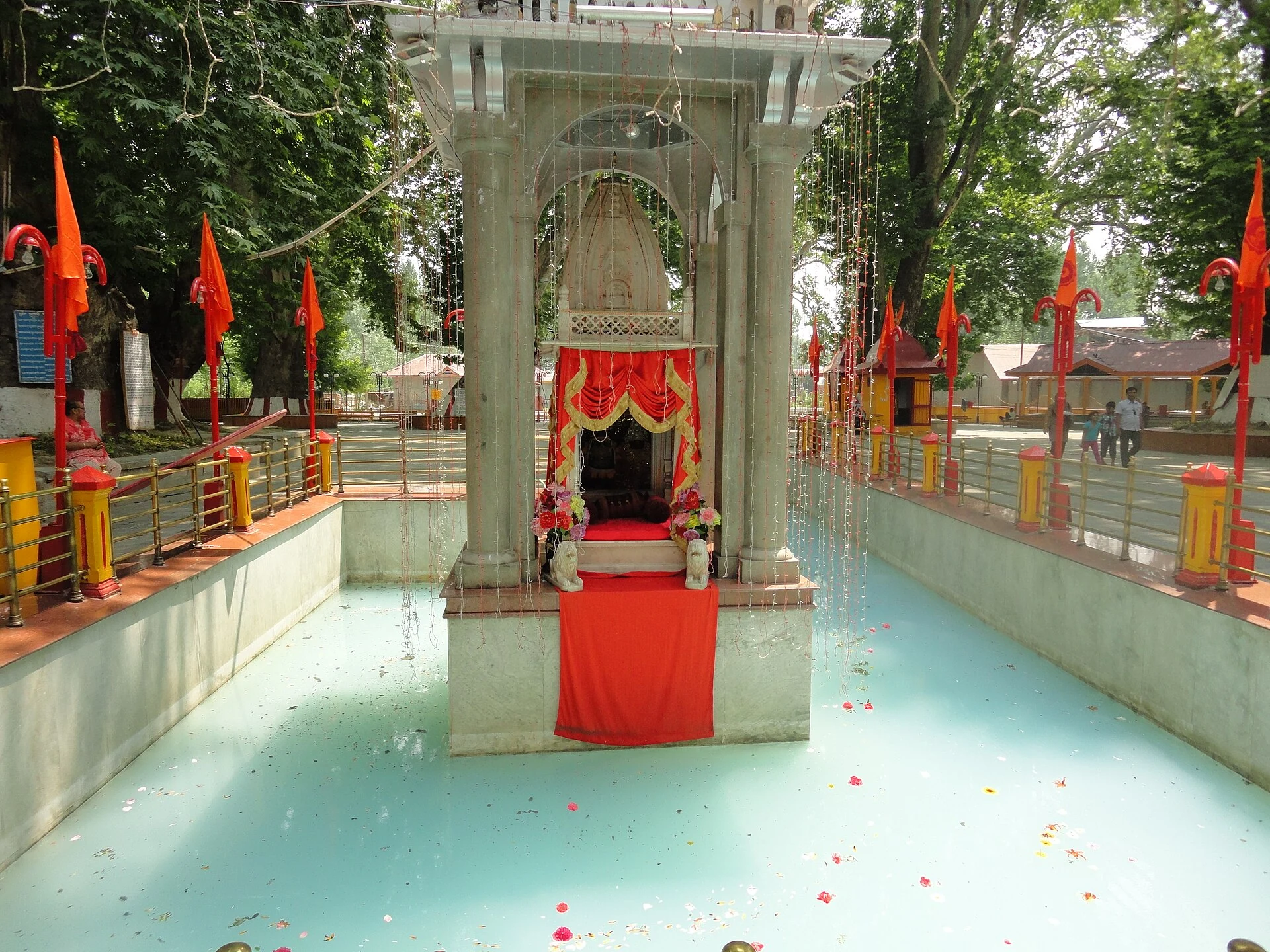
Kheer Bhawani Temple at Tulmulla in Ganderbal district is a major place of devotion for Kashmiri Hindus. The goddess is also known as Ragnya or Ragnya Devi, with several devotional forms of the name. The temple is centred on a sacred spring, making water part of its religious setting rather than simply a landscape ornament. The offering of kheer, a rice-and-milk preparation, is closely associated with the shrine’s familiar name.[1]
A spring at the centre of worship
The Ganderbal administration describes a temple situated within a natural spring and records offerings of milk and kheer. The site’s compact shrine and surrounding water create a distinctive spatial arrangement. An observer is looking at a religious enclosure whose meaning depends on the deity, water and practices of worship together. Describing the pool without that context would leave out much of the place’s identity.[1]
The secondary account identifies a many-sided spring enclosure and mature chinar trees within the precinct. It records the contributions of Dogra rulers to the temple’s construction and renovation. These later architectural phases should be distinguished from the longer devotional traditions associated with the goddess. A present building date does not establish the first moment at which people regarded a spring as sacred.[2]
Names, offerings and belief
Accounts of the shrine connect changes in the spring’s colour with devotional interpretations, including concern about adverse events. Such interpretations are beliefs attached to the sacred water. An encyclopedia can document them without presenting a colour change as a scientifically validated forecast. The same distinction applies to religious stories about the goddess: they belong to the tradition’s meaning rather than to an archaeological construction record.[2]
The name Kheer Bhawani is also used for other shrines in the region. Tulmulla is the place discussed here, and the Ganderbal district filter identifies that location. A shared deity or temple name does not mean that every record bearing the name describes the same precinct. Keeping the village and district in the article title and metadata helps readers distinguish those related places.
The annual gathering
The annual mela is associated with Jyeshtha Ashtami, with variations in the English spelling of the festival name. An Akashvani report describes the gathering at Tulmulla and the participation of devotees returning from elsewhere. The event combines worship with the experience of coming together at a place important to the community. Its date follows the religious calendar and must be checked for a particular year rather than fixed permanently to one Gregorian day.[3]
A photograph of the shrine on an ordinary day and a photograph taken during the mela would record different uses of the same space. The temple’s significance persists between those occasions, while the gathering changes the density and rhythm of the precinct. This is one reason an encyclopedia entry benefits from describing both the enduring site and the recurring event.
Compare Shankaracharya Temple for hilltop worship and Mansar Lake for another sacred water setting. Sonamarg introduces a different landscape within Ganderbal, while Raghunath Temple provides another example of religious architecture and royal patronage.
Photograph and map record
Photograph: Akshey25 via Wikimedia Commons. Licence: CC BY 3.0. Recorded capture date: 2011-06-25. Resized and converted to WebP; scene content unchanged. This is a dated view, not confirmation of the site’s present appearance.

Map marker: 34.22111111, 74.73. Representative coordinate from the secondary geographical reference; not a surveyed boundary or a verified accessible entrance. View location on OpenStreetMap · View Google Maps · Google directions · OpenStreetMap directions.
Research checked: 14 October 2026. For a visit, confirm current access, transport and opening information with the relevant authorities. This encyclopedia profile provides geographical and historical context.
Sources & references
[1] Primary place or institutional account
https://ganderbal.nic.in/tourist-place/kheer-bhawani-temple/ ↗
[2] Secondary historical and geographical reference
https://en.wikipedia.org/wiki/Kheer_Bhawani_Temple ↗
[3] Akashvani — Annual Tulmulla gathering
https://newsonair.gov.in/annual-mela-kheer-bhawani-celebrated-with-religious-fervour-in-kashmir/ ↗
Photograph and licence
https://commons.wikimedia.org/wiki/File:Kheer_Bhawani-2.jpg ↗
Related reading
Himalayan Monal: A Pheasant of Kashmir’s Mountain Forests
The Himalayan monal is a mountain pheasant occurring in the wider Himalayan region, including suitable habitats in Kashmir.
Manasbal Lake: Deep Water, Lakeside Settlement and Ecology
Manasbal is a freshwater lake in the Safapora area of Ganderbal district.
Raghunath Temple, Jammu: Dogra Patronage and Sacred Architecture
Jammu’s Raghunath temple complex, its principal deity, Dogra patronage, architecture and manuscript heritage.