
Shankaracharya Temple: Hilltop Worship and Srinagar’s Sacred Landscape
Srinagar’s Shiva temple above the city, with its sacred associations and uncertain construction chronology.
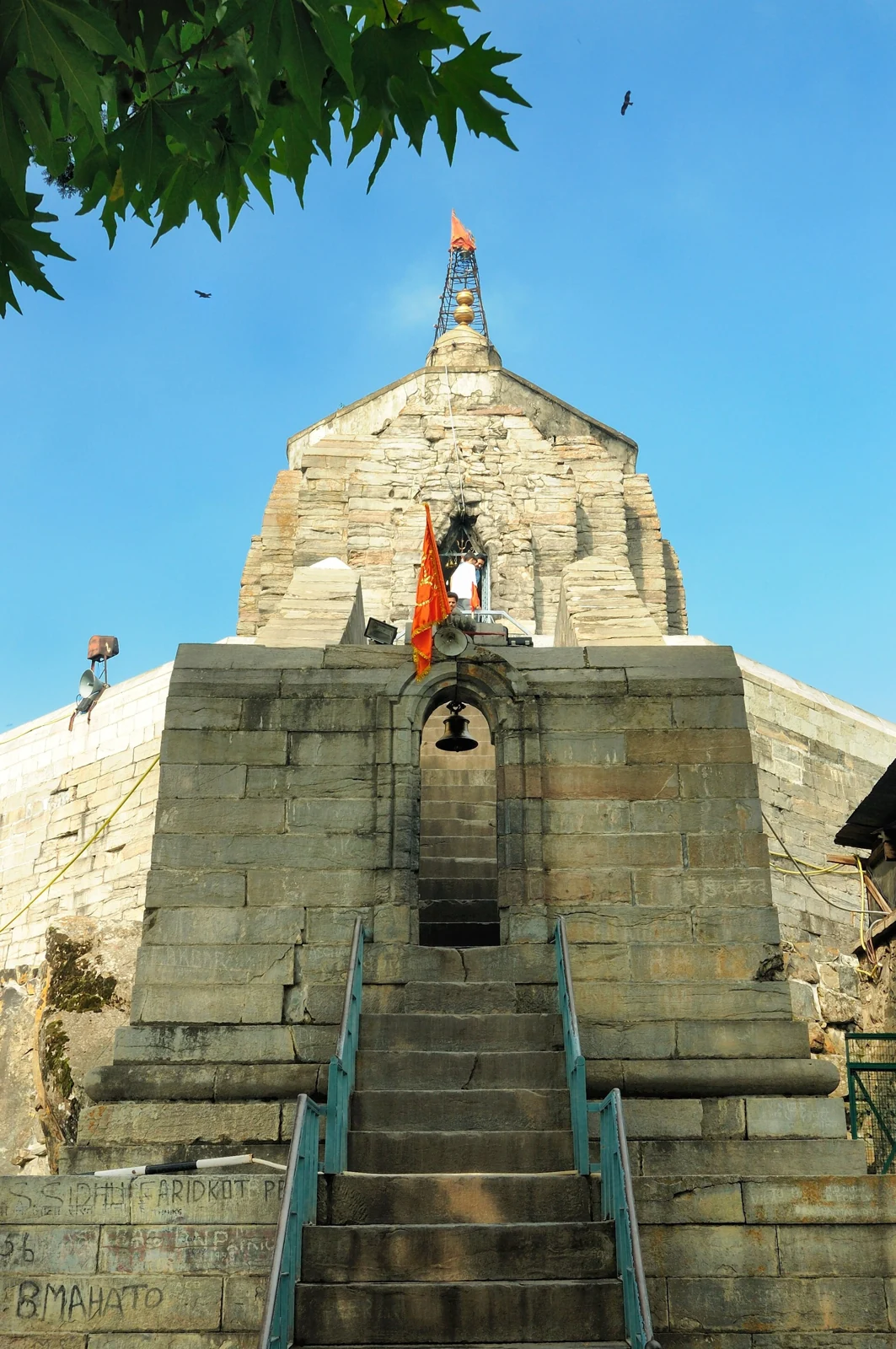
Shankaracharya Temple is a Hindu temple dedicated to Shiva on a hill above Srinagar. The hill is also known through historical names including Gopadri and Takht-i-Sulaiman, while Jyeshteshwara is another name associated with the temple. Its raised position makes it both a sacred place and a prominent point in the city’s landscape. The temple building, the hill and the philosopher whose name it bears have different historical records.[2]
Worship above the city
The Ministry of Tourism describes the Shiva dedication and the temple’s hilltop setting. The district’s places-of-interest account likewise identifies it as an important temple within Srinagar. The approach climbs away from the lakeside and settled streets towards a compact stone sanctuary. The change in height helps explain the place’s visual relationship with the city without making a claim that every modern neighbourhood was part of its original setting.[1][3]
The photograph shows the raised stone base and stair approach. These elements organise movement towards the small sanctuary above. A person viewing the temple from below encounters a different scale from the broad city and lake landscape visible from the hill. This contrast between a compact place of worship and an extensive setting is one of the monument’s distinctive characteristics.
History, association and uncertainty
The secondary historical account notes that the temple’s exact construction date is not settled. It discusses chronicle references to the hill and the association with Adi Shankara. The Ministry’s destination profile also presents more than one traditional account of its origins. A remembered visit by a religious teacher, the dedication of a shrine and the construction of the present surviving fabric need not refer to one event.[2][3]
This entry therefore does not assign an unsupported ancient year to the complete building. The site can have a long sacred history while its steps, repairs and other visible elements belong to different phases. Recognising those phases gives a stronger account than treating every stone as the same age or repeating a traditional attribution as an independently demonstrated construction record.
The sacred landscape around Srinagar
The district overview places Shankaracharya among the city’s religious and historical landmarks. Its elevated location differs from water-centred shrines and the more densely built religious spaces of the old city. These different settings show that Srinagar’s sacred geography cannot be understood through one architectural form or one relationship to the street.[1]
The secondary account connects the temple with observances such as Herath, the Kashmiri name associated with Maha Shivaratri. The meaning of the site consequently comes from recurring devotion as well as architectural survival. Visitors researching a particular observance should consult current temple information; the historical article does not establish opening arrangements, photography rules or access on a specific day.[2]
Read Kheer Bhawani for a different devotional landscape centred on a goddess and spring, and Martand Sun Temple for a different architectural and archaeological history. Dal Lake places the hill in a wider city waterscape, while Hari Parbat introduces another prominent Srinagar hill with several religious associations.
Photograph and map record
Photograph: Divya Gupta via Wikimedia Commons. Licence: CC BY-SA 3.0. Recorded capture date: 2013-09-09 09:23:17. Resized and converted to WebP; scene content unchanged. This is a dated view, not confirmation of the site’s present appearance.
.jpg)
Map marker: 34.07888889, 74.84361111. Representative coordinate from the secondary geographical reference; not a surveyed boundary or a verified accessible entrance. View location on OpenStreetMap · View Google Maps · Google directions · OpenStreetMap directions.
Research checked: 14 October 2026. For a visit, confirm current access, transport and opening information with the relevant authorities. This encyclopedia profile provides geographical and historical context.
Sources & references
[1] Primary place or institutional account
https://srinagar.nic.in/places-of-interest/ ↗
[2] Secondary historical and geographical reference
https://en.wikipedia.org/wiki/Shankaracharya_Temple ↗
[3] Ministry of Tourism — Shankaracharya Temple
https://www.incredibleindia.gov.in/en/jammu-and-kashmir/srinagar/shankaracharya-temple ↗
Photograph and licence
Related reading

Aali Masjid: Open Ground and a Historic Srinagar Mosque
Aali Masjid, also written Ali Masjid, is a historic mosque in Srinagar's Eidgah area.

Amar Singh College: Education, Campus Heritage and Institutional Change
The growth of an educational institution from a technical institute, with campus conservation and academic resources.

Bakshi Stadium: Football and a Public Sports Venue in Srinagar
Bakshi Stadium is a major sports venue in Srinagar, particularly associated with football.