
Sri Pratap Singh Museum: Objects and the History of Kashmir
The museum’s founding, diverse collection and the role of catalogues in interpreting individual objects.
The Sri Pratap Singh Museum, commonly called the SPS Museum, is a major public collection in Srinagar. The Jammu and Kashmir Department of Culture dates its establishment to 1898 and describes its origins in a Maharaja’s summer guest house, with collections transferred from the state treasury or toshkhana. The museum consequently brings together a historic building context and objects whose histories reach far beyond the date at which the institution opened.[1]
Several kinds of evidence
The department identifies archaeology, coins, decorative art, arms, paintings and textiles among the collection’s subjects. These categories preserve different kinds of knowledge. A coin can help establish a name or monetary issue; a textile records material and skilled work; a carved stone object may come from a religious or architectural setting. Their value depends on identification, provenance and interpretation as well as visual appearance.[1]
The secondary museum history describes the proposal and development of the institution and its widening collection. An institutional founding year should not be treated as the age of the objects, nor should a collection total be mistaken for the number of items visible in one gallery. Holdings, exhibits and storage are different parts of a museum’s work.[2]
Objects separated from their original settings
The National Mission on Monuments and Antiquities maintains object records associated with the SPS Museum. Its utilitarian-object listing includes identified objects and recorded provenance. Such catalogues help connect an item in a museum with the place or context from which it came. A displayed object without that information would tell a much narrower story.[3]
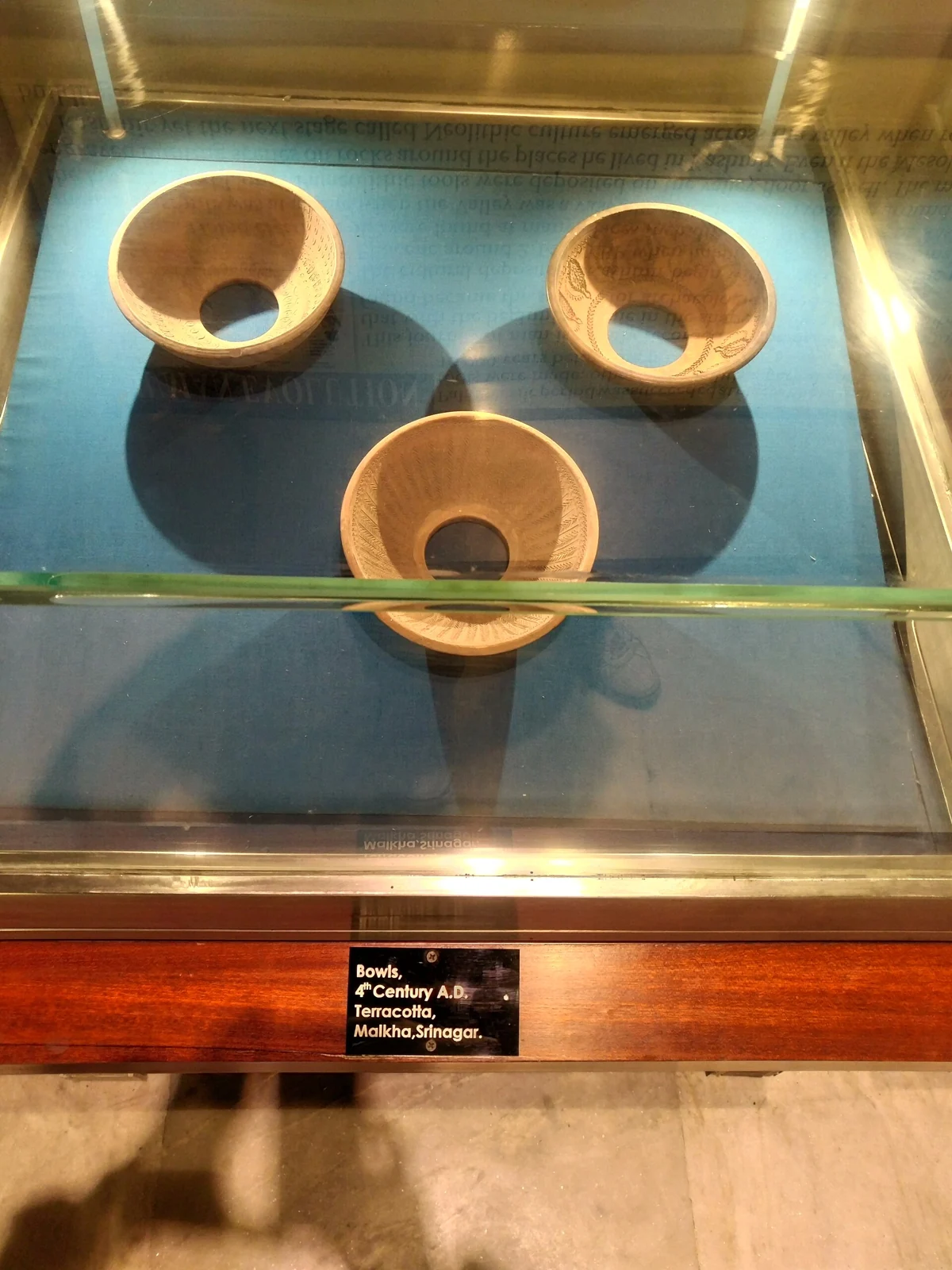
The supplied photograph shows a display of bowls in the museum, described by its source as fourth-century material. This is an image of a particular exhibit, not a photograph of the museum building or a complete representation of the collection. Its date and source description are retained so that the caption identifies what is actually illustrated.
The museum’s relationship with archaeological sites is especially useful for connected reading. A fragment, vessel or sculpture in a gallery can be studied closely, while the original site preserves relationships of layout, landscape and scale. Neither form of evidence replaces the other. The object and the place can be understood more fully when their histories are linked.
A public institution in Srinagar
The secondary reference places the museum in the Wazir Bagh–Lal Mandi part of the city’s geography. The map marker here is for the museum institution, rather than the findspot of a pictured object. Visitor information should distinguish those two locations, particularly where an exhibit originated in another district or region.[2]
Opening times, gallery access and temporary exhibitions can change. This article describes the institution and its collections through the sources checked for the batch, while practical arrangements should come from the museum’s current notice. It does not promise that every item named in a catalogue is presently on display.
What a catalogue can add to a display
The NMMA utilitarian-object listing includes a miniature pot identified by an accession-style record number and associated with Awantipora in Pulwama. The object type, recorded place and museum identity provide a chain of information that a casual gallery photograph cannot supply by itself. An accession identifier is valuable precisely because it distinguishes one catalogued item from another object of similar appearance.[3]
Reading a collection through those records makes it possible to ask more precise questions. Was an object found in excavation, transferred from an earlier collection or acquired through a different route? What material is it made from, and how was its date established? These questions should be answered for individual items rather than assumed from the age of the museum or the period named for an entire display case.
A bowl is particularly useful for making that distinction. Its form suggests a practical object, but its historical value is not confined to decoration or rarity. When supported by provenance, an ordinary vessel can contribute to understanding materials, daily use and exchange. The photograph included here introduces that kind of collection without claiming that every bowl visible has an identical date or history.
Read Awantipora Temples and Martand for archaeological places in the Kashmir Valley. Compare Amar Mahal Museum for a different collection context in Jammu, and Kashmir pashmina for the living production history behind one important textile tradition.
Photograph and map record
Photograph: Ramanathan via Wikimedia Commons. Licence: CC BY-SA 4.0. Recorded capture date: 2017-04-20 13:37:54. Resized and converted to WebP; scene content unchanged. This is a dated view, not confirmation of the site’s present appearance.

Map marker: 34.06678, 74.81312. Representative coordinate from the secondary geographical reference; not a surveyed boundary or a verified accessible entrance. View location on OpenStreetMap · View Google Maps · Google directions · OpenStreetMap directions.
Research checked: 14 October 2026. For a visit, confirm current access, transport and opening information with the relevant authorities. This encyclopedia profile provides geographical and historical context.
Sources & references
[1] Primary place or institutional account
https://culture.jk.gov.in/Museum.aspx ↗
[2] Secondary historical and geographical reference
https://en.wikipedia.org/wiki/SPS_Museum ↗
[3] NMMA — SPS Museum utilitarian-object records
https://nmma.nic.in/nmma/exploreMusObject.do?musname=PM-SPS&object=7 ↗
Photograph and licence
https://commons.wikimedia.org/wiki/File:Sri_Pratap_Singh_Museum_Bowels_4th_Century_AD.jpg ↗
Related reading

Aali Masjid: Open Ground and a Historic Srinagar Mosque
Aali Masjid, also written Ali Masjid, is a historic mosque in Srinagar's Eidgah area.
Amar Mahal: Palace Architecture and a Museum in Jammu
A nineteenth-century palace’s architecture, differing published dates and later role as a public museum.

Amar Singh College: Education, Campus Heritage and Institutional Change
The growth of an educational institution from a technical institute, with campus conservation and academic resources.
Referenced by
- Martand Sun Temple: Ruins, Royal Patronage and Kashmiri Architecture
- Awantipora Temples: Avantivarman and the Archaeology of a Royal Town
- Amar Singh College: Education, Campus Heritage and Institutional Change
- University of Kashmir: Hazratbal Campus and the Growth of Higher Education
- Amar Mahal: Palace Architecture and a Museum in Jammu
- Basohli: Ravi-side Town and a Centre of Pahari Painting
- Kashmir Carpets: Knots, Design and Artisan Work
- Ranbir Library: Reading and Public Collections in Jammu