
Khanqah-e-Moula: Shah-i-Hamdan and Kashmir’s Timber Architecture
The riverside institution associated with Shah-i-Hamdan and Kashmir’s decorated timber architecture.
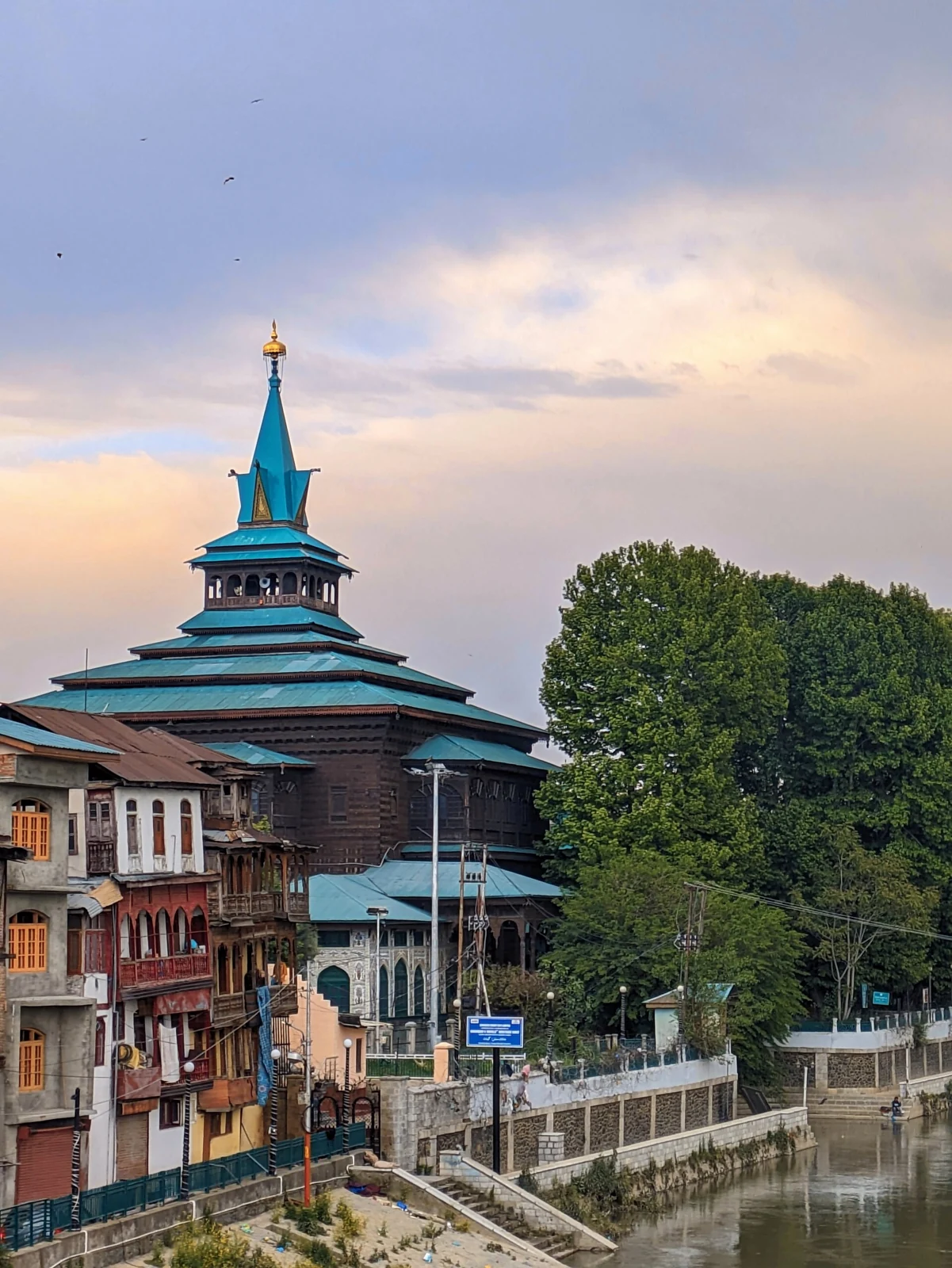
Khanqah-e-Moula, also known as Khanqah Shah-i-Hamdan, is a major Sufi-associated mosque and devotional institution on the right bank of the Jhelum in Srinagar’s old city. It commemorates Mir Sayyid Ali Hamadani, widely known as Shah-i-Hamdan. Its riverside position and timber architecture make it a recognisable part of the urban landscape, while worship and the memory of the saint give it a continuing religious role.[1]
A khanqah and a remembered teacher
The secondary historical account associates the foundation with Sultan Sikandar in 1395 and with the memory of Ali Hamadani’s fourteenth-century presence in Kashmir. A khanqah refers to an institution associated with religious teaching and a saintly tradition, not simply a synonym for every mosque. The complex’s different names express that overlap of institution, commemoration and congregational use.[2]
The heritage account places Khanqah-e-Moula between the old-city bridge areas around Fateh Kadal and Zaina Kadal. Its location makes the Jhelum part of the monument’s setting. The riverbank is a line of movement and settlement as well as a view from which the building can be recognised. Describing the shrine through the river therefore connects architecture with the history of an inhabited city.[1]
Building with timber and decorated surfaces
The heritage description identifies the layered roof, timber construction and decorative craftsmanship associated with Kashmiri architecture. The photograph shows the strong vertical emphasis of the roof and spire above the riverbank buildings. These features distinguish the complex from monuments whose appearance is dominated by a masonry dome or stone tower.[1]
The secondary account records papier-mâché decoration and successive episodes of rebuilding after fires, including damage to the spire in 2017. The institution’s historical continuity is consequently different from a claim that all its material fabric survives unchanged from the first foundation. Woodworking and surface decoration depend on maintenance and repair, which are part of the building’s history rather than exceptions to it.[2]
Faith within the old city
The wider setting contains bridges, houses, shops and other religious sites. The mosque remains part of that everyday urban environment. Its significance is not exhausted by being a picturesque riverfront landmark: the title Shah-i-Hamdan and the devotional associations of the place matter to people who use it for worship and remembrance. Looking at its skyline and understanding its institution are complementary ways of reading the same place.
The representative coordinate identifies the complex, but not every doorway or approach within its urban surroundings. The photographed view is dated and may show lighting or roof condition particular to that moment. Current conservation or access arrangements should be checked through the managing institution rather than inferred from the image.
Follow the Jhelum River entry for the old city’s wider watercourse and Jamia Masjid for another major timber-built religious institution. Charar-e-Sharief introduces the memory of Nund Rishi, while Kashmir pashmina explores a different form of skilled material production within the region.
Photograph and map record
Photograph: SerCrappucino via Wikimedia Commons. Licence: CC BY-SA 4.0. Recorded capture date: 6 May 2024 (according to Exif data). Resized and converted to WebP; scene content unchanged. This is a dated view, not confirmation of the site’s present appearance.

Map marker: 34.091248, 74.807771. Representative coordinate from the secondary geographical reference; not a surveyed boundary or a verified accessible entrance. View location on OpenStreetMap · View Google Maps · Google directions · OpenStreetMap directions.
Research checked: 14 October 2026. For a visit, confirm current access, transport and opening information with the relevant authorities. This encyclopedia profile provides geographical and historical context.
Sources & references
[1] Primary place or institutional account
https://srinagarheritage.in/p/khanqah-shah-i-hamdan ↗
[2] Secondary historical and geographical reference
https://en.wikipedia.org/wiki/Khanqah-e-Moula ↗
Photograph and licence
https://commons.wikimedia.org/wiki/File:Khanqah-e-Moula,_Srinagar.jpg ↗
Related reading

Aali Masjid: Open Ground and a Historic Srinagar Mosque
Aali Masjid, also written Ali Masjid, is a historic mosque in Srinagar's Eidgah area.

Amar Singh College: Education, Campus Heritage and Institutional Change
The growth of an educational institution from a technical institute, with campus conservation and academic resources.
Bakshi Stadium: Football and a Public Sports Venue in Srinagar
Bakshi Stadium is a major sports venue in Srinagar, particularly associated with football.